
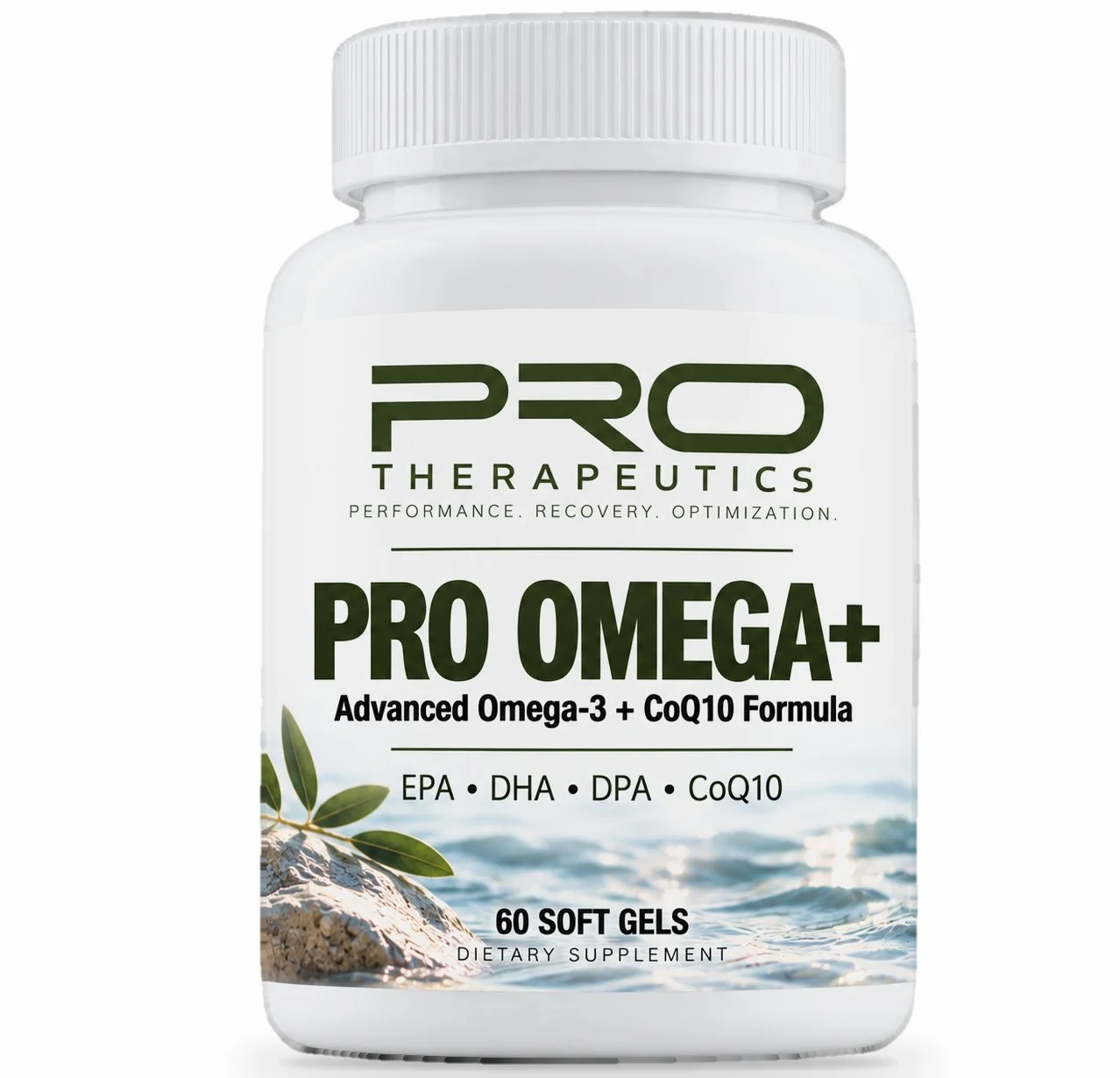
PRO OMEGA+ Advanced Fish Oil
Concentrated EPA, DHA, and DPA Omega-3s With Coenzyme Q10
PRO Sports Medicine Learning Center
Introduction
Omega-3 fatty acids are among the most studied nutrients in medicine. The long-chain marine omega-3s, EPA and DHA, are built into the membranes of nearly every cell, where they influence membrane fluidity, cell signaling, and the production of signaling molecules involved in the normal inflammatory response and its resolution. Most people get these fats almost entirely from fatty fish, and many people eat little or none.
PRO OMEGA+ is a concentrated omega-3 formula that adds a second nutrient with a complementary role: coenzyme Q10, a key component of mitochondrial energy production. Each two-soft-gel serving provides 1,900 mg of total omega-3 fatty acids in triglyceride form, including EPA, DHA, and DPA, plus 100 mg of CoQ10. Each bottle contains 60 soft gels, or 30 daily servings.
Formulation (per 2-soft-gel serving)
Total omega-3 fatty acids (triglyceride form): 1,900 mg
EPA (eicosapentaenoic acid): 720 mg
DHA (docosahexaenoic acid): 600 mg
DPA (docosapentaenoic acid): 100 mg
Coenzyme Q10: 100 mg
EPA, DHA, and DPA account for 1,420 mg of the 1,900 mg total. The Supplement Facts label lists the omega-3s "as triglycerides" and, like the product page, does not itemize the remaining 480 mg. Each two-soft-gel serving also supplies 30 calories, 3 g of total fat, and less than 5 mg of cholesterol.
Other ingredients: gelatin (capsule), glycerin, water, natural tocopherols, and rosemary extract (leaf and ascorbyl palmitate). Because the soft gels are made with gelatin and the oil comes from fish, OMEGA+ is not vegetarian. The label states the formula is made without allergens derived from gluten or yeast and without artificial colors or flavors, and the bottle contains a desiccant packet that should not be eaten.
EPA: Eicosapentaenoic Acid (720 mg)
What it is: a 20-carbon omega-3 fatty acid found in fatty fish and fish oil.
How it works: EPA is incorporated into cell membranes, where it competes with the omega-6 fatty acid arachidonic acid. It serves as the starting material for signaling molecules that are generally less inflammatory, and for specialized pro-resolving mediators that help the normal inflammatory response wind down. EPA also lowers the liver's production of triglyceride-rich particles.
What research shows: EPA and DHA consistently lower circulating triglycerides, with larger effects at higher doses and in people with higher starting levels. Evidence for preventing cardiovascular events is more nuanced: results vary considerably with dose, formulation, and the population studied, and over-the-counter fish oil at typical doses has shown modest or inconsistent effects on events in large trials.
DHA: Docosahexaenoic Acid (600 mg)
What it is: a 22-carbon omega-3 fatty acid concentrated in the brain and retina.
How it works: DHA is a structural component of cell membranes, especially in neurons and the retina, where it supports normal membrane function and signaling. It also contributes to triglyceride lowering and serves as a precursor for pro-resolving mediators.
What research shows: DHA's structural role in the brain and eye is well established, and adequate intake is important across the lifespan. Evidence that supplementation improves cognitive performance in healthy adults is limited and mixed. For more, see Brain Health.
DPA: Docosapentaenoic Acid (100 mg)
What it is: an intermediate long-chain omega-3 between EPA and DHA, naturally present in fish and seal oil.
How it works: DPA can be converted to EPA in the body and serves as a precursor for its own family of signaling molecules.
What research shows: DPA has been studied far less than EPA or DHA. It is included to round out the marine omega-3 profile rather than for a specific proven effect.
Omega-3s and Exercise Recovery
Several studies have examined EPA and DHA around exercise-induced muscle damage. Some have reported improvements in selected measures, such as strength retention, range of motion, and soreness after eccentric exercise, while others have found little effect. Overall, the evidence suggests a possible modest benefit for recovery, particularly with consistent use over several weeks, but results vary between studies. Omega-3s are best viewed as nutritional support for recovery alongside adequate protein, sleep, and training management.
Coenzyme Q10 (100 mg)
What it is: a fat-soluble compound made by the body and present in every cell, with the highest concentrations in energy-demanding organs such as the heart, muscles, and liver.
How it works: CoQ10 carries electrons in the mitochondrial electron transport chain, the final step in producing ATP, the cell's energy currency. In its reduced form, it also acts as a fat-soluble antioxidant protecting cell membranes. Production declines with age, and statin medications, which block an early step in cholesterol synthesis, also reduce the body's CoQ10 production.
What research shows: a 2022 systematic review and meta-analysis of randomized trials reported reduced fatigue scores on average with CoQ10 supplementation, with variation across groups and dosing regimens. CoQ10 has also been studied for statin-associated muscle symptoms, with mixed results. Evidence for CoQ10 in healthy, well-nourished adults is modest. For background, see Mitochondria & Cellular Energy.
Why Triglyceride Form?
Fish oil omega-3s are commonly supplied in two forms: ethyl esters, which are produced during concentration, and triglycerides, the natural form found in fish. Some studies suggest triglyceride-form omega-3s may be absorbed somewhat better, particularly when taken without a fatty meal, although taking any fish oil with food improves absorption.
Who It May Suit
Adults seeking daily omega-3 support, especially those who eat little fatty fish
Active adults and athletes prioritizing recovery
People focused on healthy triglyceride metabolism and cardiovascular nutrition
People who want omega-3s and CoQ10 combined in one product
Adults taking statins who are interested in CoQ10, after discussing it with their provider
Those building a broader health, recovery, or longevity strategy
How to Take It
Take two soft gels daily, preferably with food, or as recommended by your healthcare professional. Taking them with a meal that contains fat improves absorption and reduces fishy aftertaste. Storing the bottle in a cool place, or taking soft gels with your largest meal, can also help with aftertaste.
Safety, Interactions, and Contraindications
Common effects: heartburn, nausea, abdominal discomfort, diarrhea, or a fishy aftertaste.
Bleeding risk: omega-3s can mildly affect platelet function. Discuss with your provider if you take anticoagulant or antiplatelet medication, have a bleeding disorder, or are preparing for surgery.
CoQ10 and warfarin: CoQ10 is structurally similar to vitamin K and may reduce warfarin's effect. Do not start it while on warfarin without your provider's guidance.
CoQ10 and other medications: CoQ10 may modestly lower blood pressure and blood glucose; discuss with your provider if you take medications for these.
Atrial fibrillation: some large trials of omega-3 supplementation, especially at higher doses, have observed a higher rate of atrial fibrillation. Discuss with your provider if you have a history of heart rhythm problems.
Allergy: consult your provider if you have a fish or seafood allergy.
Pregnancy, nursing, medical conditions, and prescriptions: consult your healthcare professional before use.
Not a replacement for prescribed cardiovascular or triglyceride-lowering treatment.
How It Fits PRO Programs
OMEGA+ complements FOUNDATIONS by adding nutrients a multivitamin cannot supply in meaningful amounts. Its effects on triglycerides can be followed with the lipid markers in the PRO Core Health Panel, PRO GLP & Cardio Panel, or PRO Performance Panel. It fits naturally within the strategies described in Cardiovascular Health and Inflammaging.
FDA Disclaimer
These statements have not been evaluated by the Food and Drug Administration. This product is not intended to diagnose, treat, cure, or prevent any disease. Research on individual ingredients does not establish that this finished product produces identical outcomes.
Key References
National Institutes of Health, Office of Dietary Supplements. Omega-3 Fatty Acids: Fact Sheet for Health Professionals.
Heileson JL, et al. Long-Chain Omega-3 Fatty Acid Supplementation and Exercise-Induced Muscle Damage: EPA or DHA? Med Sci Sports Exerc. 2024.
Tsuchiya Y, et al. Eicosapentaenoic and docosahexaenoic acids-rich fish oil supplementation attenuates strength loss and limited joint range of motion after eccentric contractions. Eur J Appl Physiol. 2016.
Tsai IC, et al. Effectiveness of Coenzyme Q10 Supplementation for Reducing Fatigue: A Systematic Review and Meta-Analysis of Randomized Controlled Trials. Front Pharmacol. 2022.
Clinical Perspective
Omega-3 supplementation is a reasonable, well-studied choice for people who eat little fatty fish, with its most consistent measurable effect on triglycerides. Expectations for recovery and cardiovascular outcomes should be realistic. Adding CoQ10 provides mitochondrial support that may be particularly relevant for older adults and people taking statins. Attention to blood thinners, heart rhythm history, and fish allergy keeps use safe.