
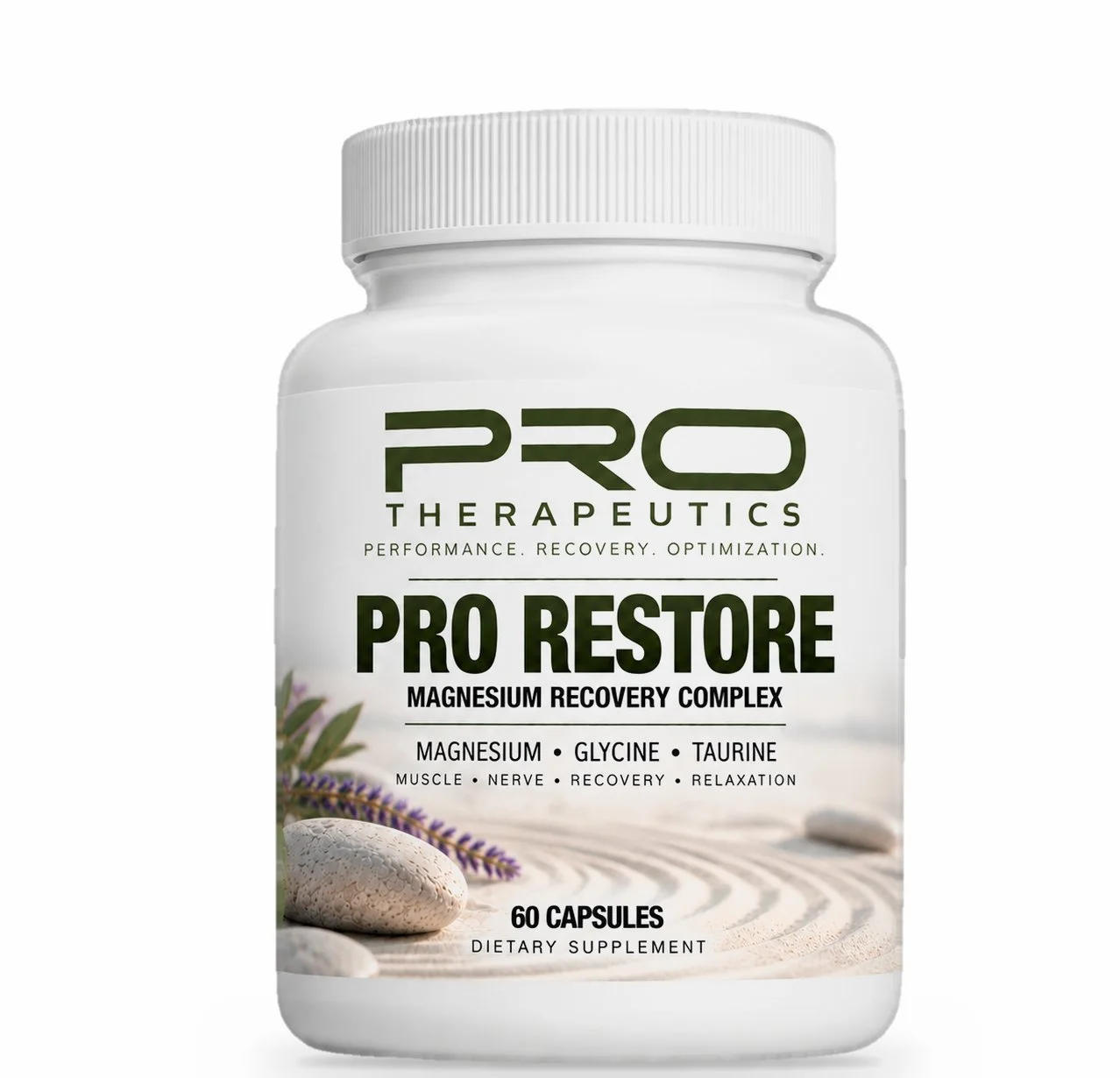
PRO RESTORE Magnesium Recovery Complex
Magnesium Bisglycinate, Glycine, and Taurine for Muscle, Nerve, and Evening Recovery Support
PRO Sports Medicine Learning Center
Introduction
Recovery is where training adaptations happen. Muscles repair, nerves reset, and the body restores its balance of fluids and electrolytes. Magnesium is central to many of those processes, and national nutrition surveys have consistently found that a large share of adults consume less magnesium than recommended.
PRO RESTORE is a focused recovery formula built around three ingredients with complementary roles: magnesium as magnesium bisglycinate, and the amino acids glycine and taurine. It is designed as a simple, non-sedating evening routine that supports normal muscle and nerve function. Each bottle contains 60 capsules, or 30 two-capsule daily servings.
Formulation (per 2-capsule serving)
Magnesium (as magnesium bisglycinate): 200 mg
Glycine: 500 mg
Taurine: 500 mg
Ingredient amounts are from the product page. Refer to the Supplement Facts label on your bottle for complete product information, including other ingredients.
Magnesium (200 mg, as Bisglycinate)
What it is: an essential mineral, the fourth most abundant in the body, stored mainly in bone and muscle.
How it works: magnesium is a cofactor for hundreds of enzymes. It is required for ATP, the cell's energy molecule, to function; for protein synthesis; and for DNA and RNA production. In muscle, calcium triggers contraction and magnesium helps muscle fibers relax. In nerves, magnesium regulates ion channels and helps maintain normal excitability. It also participates in blood sugar regulation and blood pressure physiology.
Why bisglycinate: magnesium bisglycinate binds magnesium to two glycine molecules. Chelated forms like this are generally well tolerated and less likely to cause loose stools than magnesium oxide, the cheapest and most common form. Different forms vary in solubility and absorption, though head-to-head human data are limited.
What research shows: magnesium's roles in muscle, nerve, and energy metabolism are well established, and supplementation reliably helps people with low intake. Research on magnesium for sleep quality, muscle cramps, and exercise performance in people who are not deficient is mixed, with some studies showing modest benefits and others none. The most honest summary is that magnesium is valuable for people whose intake is low, which is common.
Glycine (500 mg)
What it is: the simplest amino acid, made by the body and abundant in collagen.
How it works: glycine is a building block for proteins, especially collagen, and for glutathione, a major cellular antioxidant. It also acts as an inhibitory neurotransmitter in the spinal cord and brainstem.
What research shows: small studies have examined glycine, usually at doses of around 3 grams taken before bed, for subjective sleep quality, with some positive findings. The 500 mg dose in RESTORE is lower than those studies, and no specific clinical outcome is claimed for glycine at this dose. It is included as a complementary ingredient.
Taurine (500 mg)
What it is: an amino sulfonic acid found in high concentrations in muscle, heart, brain, and retina. The body makes some taurine, and meat and seafood supply the rest.
How it works: taurine helps regulate cell volume and the movement of ions such as calcium across cell membranes, which matters for muscle contraction. It also supports bile acid formation and has antioxidant properties.
What research shows: taurine has been studied for exercise performance and muscle damage at a range of doses, typically 1 to 6 grams. Systematic reviews, including reviews published in 2021 and 2025, report mixed findings with generally low-certainty evidence: some studies show modest benefits for endurance or markers of muscle damage, others do not. The 500 mg dose in RESTORE is at the lower end, and the formula has not itself been clinically tested.
Who It May Suit
Active adults and athletes focused on recovery nutrition
People who want to increase magnesium intake, particularly those who eat few leafy greens, nuts, seeds, legumes, or whole grains
Individuals supporting normal muscle and nerve function
People building a consistent evening routine
People with physically demanding jobs or lifestyles
Those who prefer a well-tolerated magnesium form
How to Take It
Take two capsules daily, preferably in the evening, or as recommended by your healthcare professional. RESTORE is designed for consistent daily use rather than as-needed use. Use it alongside adequate hydration, nutrition, and sleep. It is not a sleep medication, and it does not replace good sleep habits; for more, see Sleep, Recovery & Circadian Health.
Safety, Interactions, and Contraindications
Digestive effects: magnesium can cause diarrhea, nausea, or abdominal cramping, especially at higher doses. Chelated forms are generally better tolerated.
Upper limit: the NIH adult tolerable upper intake level for magnesium from supplements and medications is 350 mg per day, not counting magnesium in food. RESTORE provides 200 mg. If you also take PRO FOUNDATIONS (100 mg magnesium), your combined supplemental intake is 300 mg. Account for any other magnesium-containing products, including antacids and laxatives.
Medication interactions: magnesium can reduce absorption of certain antibiotics (tetracyclines and fluoroquinolones) and bisphosphonates used for bone health. Separate doses by several hours, as your pharmacist or provider advises.
Kidney function: people with reduced kidney function may accumulate magnesium and should use supplements only with medical guidance.
Pregnancy, nursing, medical conditions, and prescriptions: consult a qualified healthcare professional before use.
Not a substitute for medical care, prescribed treatment, adequate sleep, or nutrition.
How It Fits PRO Programs
RESTORE completes the daily foundation: FOUNDATIONS during the day, OMEGA+ with meals, and RESTORE in the evening. It is especially relevant for patients in demanding training blocks, those recovering from injury in PRO's sports medicine programs, and patients eating less during weight management. Kidney function, which matters for magnesium safety, is measured in the PRO GLP & Cardio Panel and PRO Performance Panel. For more on recovery physiology, see Exercise as Medicine.
FDA Disclaimer
These statements have not been evaluated by the Food and Drug Administration. This product is not intended to diagnose, treat, cure, or prevent any disease. Studies cited relate to individual ingredients and may use different doses or formulations; they do not establish that PRO RESTORE itself will produce the same outcomes.
Key References
National Institutes of Health, Office of Dietary Supplements. Magnesium: Fact Sheet for Health Professionals.
Kurtz JA, et al. The Dose Response of Taurine on Aerobic and Strength Exercises: A Systematic Review. 2021.
Deng H, et al. Does One Shot Work? The Acute Impact of a Single Taurine Dose on Exercise Performance: A Meta-Analytic Review. 2025.
Clinical Perspective
Magnesium is one of the most common nutrient shortfalls in active adults, and a well-tolerated chelated form taken consistently is a sensible, low-risk way to close that gap. Glycine and taurine add complementary support at modest doses, and their evidence should be described honestly as limited. The main safety considerations are cumulative magnesium intake, kidney function, and timing around certain antibiotics and bone medications.