
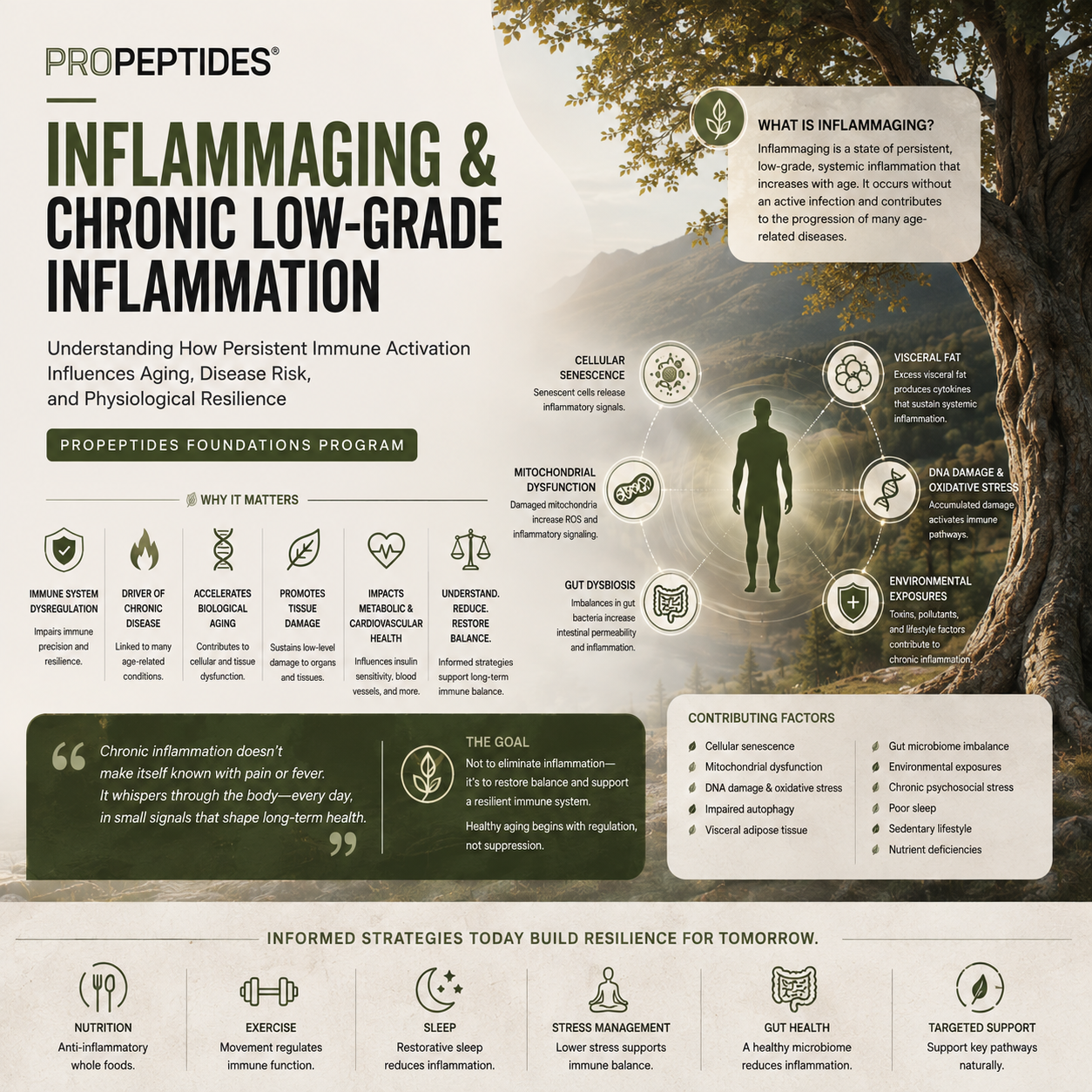
Inflammaging & Chronic Low-Grade Inflammation
Understanding How Persistent Immune Activation Influences Aging, Disease Risk, and Physiological Resilience
PROPeptides Foundations Program
Introduction
Inflammation is one of the body's most important protective responses.
When tissue is injured or an infection develops, the immune system rapidly activates a coordinated series of events designed to eliminate threats, remove damaged cells, and initiate repair. Blood vessels become more permeable, immune cells enter the affected tissue, and chemical messengers organize the healing response.
Under normal conditions, inflammation is temporary.
It begins when needed, resolves when the threat has passed, and allows tissue to return to a stable state.
With aging, however, this process may gradually change.
Rather than fully resolving, inflammatory signaling can remain persistently elevated at a low level throughout the body. This chronic, often clinically silent state is known as inflammaging.
Inflammaging differs from the intense inflammation caused by an acute infection or injury. It may not produce fever, visible swelling, or obvious pain. Instead, it develops gradually and can influence metabolism, cardiovascular function, immune regulation, brain health, muscle maintenance, and tissue repair over many years.
Chronic inflammation is now recognized as one of the major hallmarks of aging because it both results from age-related cellular dysfunction and contributes to the progression of that dysfunction. ()
What Is Inflammaging?
Inflammaging describes a state of persistent, low-grade, systemic inflammation that becomes more common with advancing age.
It is generally characterized by modest elevations in inflammatory mediators rather than the dramatic immune response seen during acute illness.
These mediators may include:
C-reactive protein
Interleukin-6
Tumor necrosis factor-alpha
Interleukin-1 beta
Other inflammatory cytokines and chemokines
Inflammaging is often described as sterile inflammation because it can persist without an active infection.
The immune system remains partially activated, but there may be no single pathogen or injury responsible for sustaining that response.
Instead, inflammaging develops through the cumulative influence of cellular damage, metabolic dysfunction, senescent cells, altered immune regulation, environmental exposures, and declining tissue maintenance. ()
Acute and Chronic Inflammation Are Not the Same
Inflammation itself is not inherently harmful.
Acute inflammation
Acute inflammation is a rapid, temporary response to a specific threat.
Examples include:
A bacterial infection
A muscle strain
A surgical incision
A tendon injury
A viral illness
This response helps isolate damage, recruit immune cells, remove injured tissue, and begin repair.
Chronic inflammation
Chronic inflammation persists after the original threat has resolved or develops without a clearly defined acute trigger.
Rather than supporting recovery, persistent inflammatory signaling may gradually alter tissue structure and function.
The biological problem is therefore not inflammation alone.
It is the failure to appropriately regulate and resolve inflammation.
The Immune System Changes With Age
The immune system does not simply become weaker with aging.
It becomes dysregulated.
Some immune responses decline, while others remain persistently activated.
This age-related remodeling is known as immunosenescence.
Common changes include:
Reduced production of naïve T cells
Altered B-cell function
Less effective immune memory
Impaired vaccine responses
Reduced pathogen recognition
Chronic activation of innate immunity
Changes in macrophage and natural killer cell function
This creates an apparent paradox.
Older adults may become less capable of mounting a precise response to a new infection while simultaneously experiencing more background inflammation.
Immunosenescence and inflammaging are related but distinct processes. One describes altered immune performance; the other describes the chronic inflammatory environment that often accompanies aging. ()
Where Chronic Inflammation Comes From
Inflammaging does not arise from one single source.
It develops through the interaction of multiple biological processes.
Important contributors include:
Cellular senescence
Mitochondrial dysfunction
DNA damage
Oxidative stress
Impaired autophagy
Visceral adipose tissue
Changes in the gut microbiome
Persistent infections
Environmental exposures
Metabolic dysfunction
Each of these processes can activate immune signaling.
As they accumulate, the immune system receives a continuous stream of low-level danger signals that may prevent inflammation from fully resolving.
Damage-Associated Molecular Patterns
The immune system does not respond only to bacteria and viruses.
It also recognizes signals released by injured or dysfunctional cells.
These molecules are known as damage-associated molecular patterns, or DAMPs.
Examples include:
Mitochondrial DNA
Extracellular ATP
Damaged proteins
Nuclear fragments
Oxidized lipids
Cellular debris
When these materials appear outside their normal cellular location, immune cells may interpret them as evidence of tissue injury.
Pattern-recognition receptors then activate inflammatory pathways intended to eliminate the threat.
During aging, declining autophagy and impaired cellular clearance can allow DAMPs to accumulate, sustaining immune activation even in the absence of infection. ()
Cellular Senescence and the SASP
Senescent cells are metabolically active cells that have permanently stopped dividing.
Although cellular senescence can protect against cancer and assist with wound healing, senescent cells may become problematic when they accumulate.
Many senescent cells release a mixture of:
Inflammatory cytokines
Chemokines
Growth factors
Proteases
Profibrotic signaling molecules
This collection of secreted factors is called the senescence-associated secretory phenotype, or SASP.
The SASP can attract immune cells and help remove senescent cells under healthy conditions.
With aging, however, immune clearance may become less effective.
Senescent cells then remain in tissues and continue releasing inflammatory signals, contributing to persistent inflammation and dysfunction in neighboring cells.
This creates a self-reinforcing cycle in which cellular senescence promotes inflammation, and inflammation promotes additional cellular damage and senescence.
Mitochondrial Dysfunction Promotes Inflammation
Mitochondria play a central role in inflammaging.
Damaged mitochondria may:
Produce excessive reactive oxygen species
Generate less ATP
Release mitochondrial DNA
Activate intracellular immune pathways
Impair cellular stress responses
Because mitochondria evolved from ancient bacteria, mitochondrial components resemble microbial material.
When mitochondrial DNA or proteins escape into the cytoplasm or extracellular space, the immune system may respond as though a pathogen were present.
This can activate inflammatory pathways including the inflammasome and cyclic GMP-AMP synthase–stimulator of interferon genes system, commonly abbreviated as the cGAS–STING pathway.
Efficient mitophagy normally limits this response by removing dysfunctional mitochondria before their contents escape.
As mitochondrial quality control declines, inflammatory signaling may increase.
The Inflammasome
The inflammasome is a molecular complex that detects cellular stress, infection, and tissue damage.
One of the most extensively studied inflammasomes is NLRP3.
When activated, the NLRP3 inflammasome promotes production of inflammatory cytokines including:
Interleukin-1 beta
Interleukin-18
Inflammasome activation may be triggered by:
Mitochondrial dysfunction
Reactive oxygen species
Cholesterol crystals
Uric acid crystals
Extracellular ATP
Cellular debris
Temporary inflammasome activation can be protective.
Persistent activation, however, has been implicated in metabolic disease, cardiovascular dysfunction, neuroinflammation, and other age-associated conditions.
Visceral Fat Is an Inflammatory Organ
Adipose tissue is not simply a passive storage site for excess calories.
It is an active endocrine and immune organ.
This is particularly true of visceral adipose tissue, the fat that surrounds internal organs.
As visceral fat expands:
Fat cells become enlarged.
Local oxygen supply may become inadequate.
Cellular stress increases.
Macrophages accumulate.
Pro-inflammatory cytokines are released.
Insulin sensitivity declines.
This inflammatory environment can affect tissues throughout the body.
Visceral adiposity therefore contributes not only to metabolic dysfunction but also to systemic chronic inflammation.
This connection helps explain why body composition can influence biological aging independently of total body weight.
The Gut Microbiome and Intestinal Barrier
The gastrointestinal tract contains trillions of microorganisms that interact continuously with the immune system.
A healthy intestinal barrier allows nutrients to pass into circulation while limiting the movement of bacterial products.
With aging, the composition of the gut microbiome may change.
At the same time, intestinal barrier integrity may decline.
This can allow small amounts of microbial products, including lipopolysaccharide, to enter the circulation and stimulate systemic immune activity.
This process is sometimes described as metabolic endotoxemia.
Diet, medications, infections, activity levels, and numerous environmental factors can influence the microbiome, making this one of the most complex and individualized contributors to inflammaging.
Inflammaging and Cardiovascular Disease
Chronic inflammation plays a major role in atherosclerosis.
Inflammatory signaling contributes to:
Endothelial dysfunction
Oxidation of lipoproteins
Recruitment of immune cells into arterial walls
Formation and progression of plaque
Plaque instability
Thrombotic risk
Atherosclerosis is therefore not simply a disorder of cholesterol accumulation.
It is a chronic inflammatory disease involving lipids, vascular cells, immune cells, and tissue repair pathways.
This does not diminish the importance of blood pressure, cholesterol, glucose control, or smoking avoidance. Instead, it demonstrates how these risk factors interact through shared inflammatory biology.
Inflammaging and Metabolic Dysfunction
Inflammatory cytokines can interfere with insulin signaling.
Over time, persistent inflammation may contribute to:
Insulin resistance
Elevated blood glucose
Visceral fat accumulation
Fatty liver disease
Impaired metabolic flexibility
Metabolic dysfunction can then further promote inflammation through adipose tissue stress, mitochondrial dysfunction, and oxidative injury.
This creates another self-reinforcing cycle:
Inflammation worsens metabolic function, and impaired metabolism produces additional inflammation.
Inflammaging and the Brain
The central nervous system possesses its own specialized immune cells known as microglia.
Microglia continuously monitor the brain for infection, injury, and damaged cellular material.
With aging, microglia may become more reactive and less effective at returning to a resting state after activation.
Persistent neuroinflammatory signaling has been associated with:
Cognitive decline
Impaired synaptic function
Reduced neuronal resilience
Neurodegenerative disease
Inflammation alone does not explain disorders such as Alzheimer's or Parkinson's disease.
However, it may interact with protein aggregation, mitochondrial dysfunction, vascular disease, and impaired cellular clearance to influence their development and progression.
Inflammation and Skeletal Muscle
Chronic inflammation also affects skeletal muscle.
Elevated inflammatory signaling may contribute to:
Reduced muscle protein synthesis
Increased protein breakdown
Impaired satellite cell function
Reduced recovery from exercise
Insulin resistance
Age-related loss of muscle mass
This gradual decline in muscle quantity and function is known as sarcopenia.
Maintaining muscle therefore has implications far beyond strength or appearance.
Skeletal muscle acts as a metabolic organ, glucose reservoir, endocrine tissue, and major contributor to long-term functional independence.
Inflammation Is Not Fully Captured by One Laboratory Test
Several biomarkers may provide information about systemic inflammation.
Common examples include:
High-sensitivity C-reactive protein
Erythrocyte sedimentation rate
Ferritin
Interleukin-6
Fibrinogen
Complete blood count patterns
However, no single laboratory value definitively measures inflammaging.
Inflammatory markers can be affected by:
Acute illness
Recent exercise
Obesity
Sleep deprivation
Autoimmune disease
Infection
Tissue injury
Medication use
Interpretation therefore requires clinical context and, when appropriate, repeated measurements rather than reliance on one isolated result.
Inflammaging is a biological pattern, not a single laboratory diagnosis.
Lifestyle and Inflammatory Regulation
Lifestyle does not eliminate every source of inflammation, but it strongly influences inflammatory balance.
Evidence-based strategies include:
Regular aerobic activity
Resistance training
Adequate sleep
Smoking avoidance
Reduction of visceral adiposity
Metabolic risk-factor control
Nutrient-dense dietary patterns
Management of periodontal disease
Treatment of chronic infections
Appropriate recovery from exercise
Physical activity is particularly important.
A single strenuous workout may temporarily increase inflammatory signals, but regular exercise generally improves immune regulation, reduces visceral fat, enhances mitochondrial quality, and lowers chronic systemic inflammation over time.
This distinction between temporary and persistent inflammation is essential.
Nutrition and Inflammaging
Diet influences inflammation through multiple pathways.
These include:
Blood glucose regulation
Adipose tissue biology
Gut microbiome composition
Oxidative stress
Lipid metabolism
Nutrient sufficiency
Dietary patterns emphasizing:
Vegetables
Fruits
Legumes
Whole grains
Fish
Nuts
Seeds
Unsaturated fats
are generally associated with more favorable inflammatory and cardiometabolic profiles.
In contrast, diets consistently high in highly refined carbohydrates, excess energy, trans fats, and heavily processed foods may contribute to metabolic dysfunction and chronic inflammation.
No single food determines inflammatory health.
The overall dietary pattern matters more than isolated ingredients.
Where Peptides Enter Inflammation Research
Peptide signaling is deeply involved in immune regulation.
Some peptides function naturally as:
Cytokines
Chemokines
Growth factors
Hormones
Antimicrobial signals
Tissue-repair mediators
Several investigational peptides are being studied for potential effects on inflammatory pathways.
Examples include:
KPV, a short peptide fragment derived from alpha-melanocyte-stimulating hormone that has demonstrated anti-inflammatory activity in preclinical research.
Thymosin beta-4, which has been investigated for its roles in cell migration, tissue repair, and inflammatory regulation.
BPC-157, which remains investigational and has primarily been studied in animal and laboratory models.
Mitochondrial-targeted peptides that may indirectly reduce inflammatory signaling by improving mitochondrial function.
These compounds differ substantially in mechanism, evidence quality, regulatory status, and clinical development.
No investigational peptide should be assumed to broadly treat inflammaging, and no peptide has been approved specifically to reverse chronic age-related inflammation in otherwise healthy individuals.
Why Suppressing All Inflammation Is Not the Goal
Because chronic inflammation is associated with disease, it may seem logical to suppress the immune system as much as possible.
That approach would be biologically inappropriate.
Inflammation is required for:
Fighting infection
Healing wounds
Adapting to exercise
Removing damaged cells
Coordinating tissue regeneration
Responding to cancerous cells
Excessive anti-inflammatory treatment may impair these protective functions.
The objective is not complete immune suppression.
It is restoration of appropriate immune regulation—strong when needed, restrained when unnecessary, and capable of resolving once the threat has passed.
Bringing It All Together
Inflammaging is a chronic, low-grade inflammatory state that develops through the interaction of immune aging, cellular senescence, mitochondrial dysfunction, metabolic disease, impaired autophagy, visceral adiposity, and altered tissue signaling. Unlike acute inflammation, which protects the body during infection and injury, inflammaging may persist without an obvious trigger and gradually influence nearly every organ system.
This persistent immune activation can impair metabolic function, promote cardiovascular disease, reduce muscle maintenance, disrupt brain health, and further accelerate other hallmarks of aging. At the same time, those hallmarks generate additional danger signals that reinforce inflammation. The result is not a single linear pathway but a network of mutually amplifying biological disturbances.
Healthy aging therefore does not require eliminating inflammation. It requires preserving the body's ability to activate inflammation appropriately, resolve it efficiently, and prevent low-grade immune signaling from becoming a permanent physiological state.
Looking Ahead
Inflammation is only one component of the immune system's transformation with age. While some immune pathways remain chronically activated, other components lose their ability to recognize new pathogens, generate effective memory responses, and coordinate precise defense. This broader decline in immune performance is known as immunosenescence.
In the next article, we will explore Immunosenescence & Immune Resilience, examining how innate and adaptive immunity change with age, why older adults may experience both increased inflammation and reduced infection resistance, and how vaccination, exercise, sleep, nutrition, and emerging therapies may influence immune health across the lifespan.
Key References
Franceschi C, Garagnani P, Parini P, Giuliani C, Santoro A. Inflammaging: A New Immune–Metabolic Viewpoint for Age-Related Diseases. Nature Reviews Endocrinology. 2018. ()
Ferrucci L, Fabbri E. Inflammageing: Chronic Inflammation in Ageing, Cardiovascular Disease, and Frailty.Nature Reviews Cardiology. 2018. ()
Furman D, Campisi J, Verdin E, et al. Chronic Inflammation in the Etiology of Disease Across the Life Span. Nature Medicine. 2019. ()
López-Otín C, Blasco MA, Partridge L, Serrano M, Kroemer G. Hallmarks of Aging: An Expanding Universe. Cell. 2023. ()
Li X, Li C, Zhang W, et al. Inflammation and Aging: Signaling Pathways and Intervention Therapies. Signal Transduction and Targeted Therapy. 2023. ()
Baechle JJ, Chen N, Makhijani P, et al. Chronic Inflammation and the Hallmarks of Aging. Molecular Metabolism. 2023. ()
Liu Z, Liang Q, Ren Y, et al. Immunosenescence: Molecular Mechanisms and Diseases. Signal Transduction and Targeted Therapy. 2023. ()
Jurk D, Wilson C, Passos JF, et al. Chronic Inflammation Induces Telomere Dysfunction and Accelerates Ageing in Mice. Nature Communications. 2014. ()
Clinical Perspective
Inflammaging provides a useful framework for understanding why aging increases susceptibility to many seemingly unrelated chronic conditions. Cardiovascular disease, insulin resistance, frailty, neurodegeneration, and sarcopenia involve different tissues, yet all may be influenced by persistent inflammatory signaling. The clinical challenge is that inflammaging is heterogeneous and cannot be diagnosed or managed through one biomarker, supplement, or medication.
Evaluation should focus on modifiable contributors such as visceral adiposity, poor metabolic control, smoking, sleep disruption, physical inactivity, periodontal disease, chronic infection, and inadequate recovery. Elevated inflammatory markers may help identify risk, but they require interpretation within the broader clinical picture.
Investigational peptides may eventually provide targeted methods for modifying specific inflammatory pathways, but current evidence does not support treating inflammation as a single isolated longevity target. The strongest clinical foundation remains preservation of muscle, metabolic health, cardiovascular risk reduction, regular physical activity, restorative sleep, and treatment of identifiable inflammatory disease.