
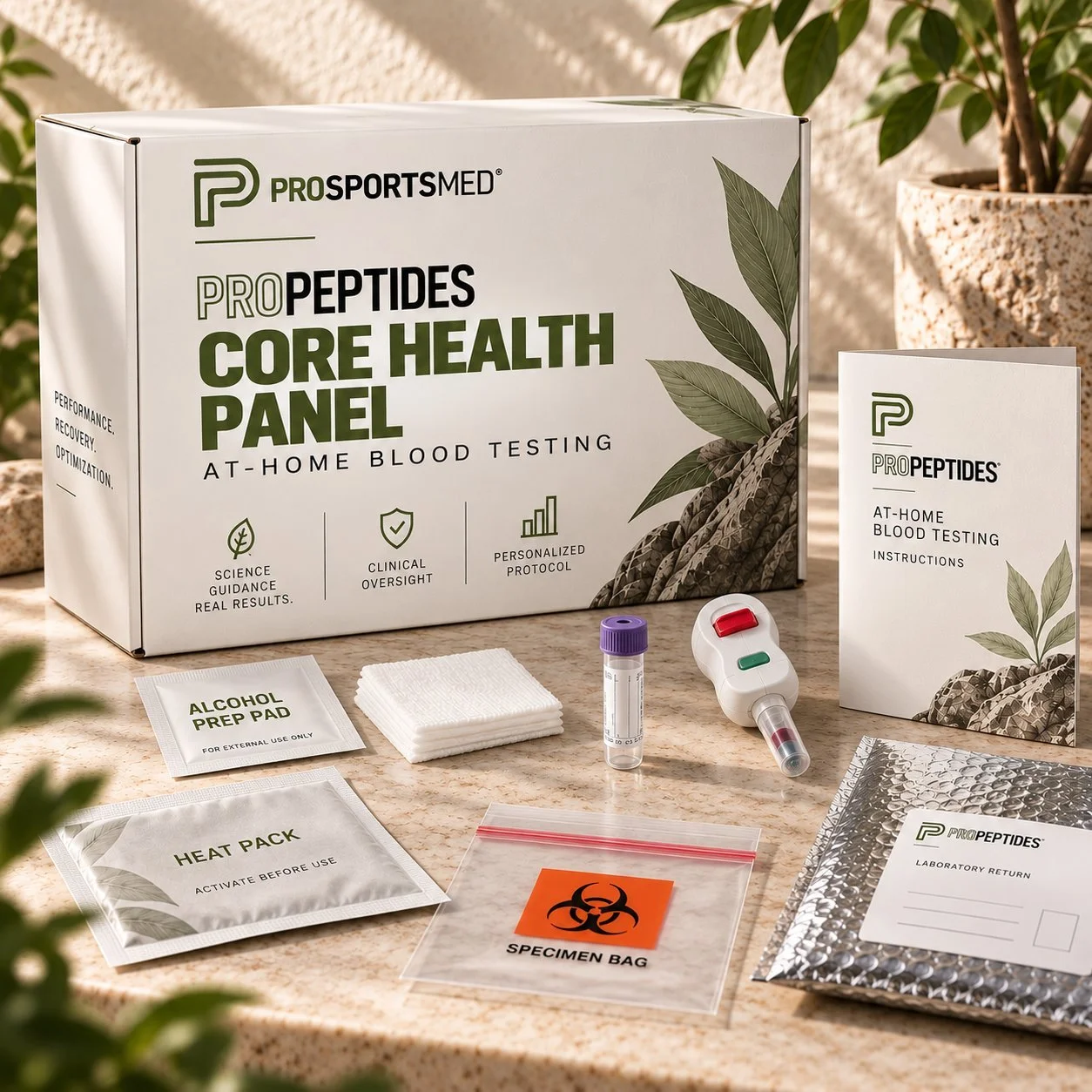
PRO Core Health Panel
A Foundational Baseline for Heart, Metabolic, Thyroid, Nutrient, and Hormone Health
PRO Sports Medicine Learning Center
Introduction
Every health plan needs a starting point. The PRO Core Health Panel is designed to be that starting point: a focused, at-home blood test that looks at the systems most likely to shape long-term health, including cardiovascular risk, blood sugar regulation, inflammation, thyroid function, nutrient status, and sex hormones.
The panel reports 18 biomarkers for men and 16 for women. The difference reflects the sex-specific hormone markers in each configuration. It uses a single EasyDraw capillary collection device, so it is one of the simplest panels to complete at home.
For many patients, the Core Health Panel is the first test they take when joining PRO Foundations, starting a nutrition or training program, or simply wanting to know their numbers.
What the Panel Measures
Cardiovascular and cholesterol health: total cholesterol, HDL cholesterol, LDL cholesterol, triglycerides, apolipoprotein B (ApoB), VLDL (calculated), calculated LDL-to-HDL and LDL-to-ApoB ratios, and a triglyceride-to-HDL ratio.
Metabolic health and inflammation: hemoglobin A1c (HbA1c) and high-sensitivity C-reactive protein (hsCRP).
Thyroid: thyroid-stimulating hormone (TSH).
Nutrient and iron status: vitamin D and ferritin.
Male panel only: total testosterone, free testosterone (calculated), sex hormone-binding globulin (SHBG), and albumin.
Female panel only: estradiol and follicle-stimulating hormone (FSH).
Cholesterol and Lipids
Total cholesterol is the sum of cholesterol carried in all lipoprotein particles. On its own it is a blunt tool, because it combines "good" and "bad" fractions, but it provides useful context.
LDL cholesterol measures cholesterol carried in low-density lipoproteins, the particles most closely tied to the buildup of plaque in artery walls. Diet, genetics, body weight, thyroid function, and certain medications all influence LDL. Many laboratories flag values at or above 100 mg/dL, and treatment targets are individualized based on overall cardiovascular risk.
HDL cholesterol reflects cholesterol carried in high-density lipoproteins, which participate in moving cholesterol away from tissues. Low HDL is associated with higher cardiovascular risk. Regular aerobic exercise, not smoking, and healthy body composition tend to support HDL, though raising HDL with medication has not been shown to reduce risk.
Triglycerides are the main storage form of fat in the blood. They are highly sensitive to recent meals, alcohol, refined carbohydrates, and insulin resistance. A fasting value under 150 mg/dL is commonly considered within the normal range.
VLDL (calculated) estimates cholesterol in very-low-density lipoproteins, particles that carry triglycerides from the liver. Because it is calculated from triglycerides, it rises and falls with them.
Cholesterol and triglyceride ratios compare atherogenic lipids with HDL. Ratios can add perspective, especially the triglyceride-to-HDL relationship, which tends to rise with insulin resistance. The LDL-to-HDL ratio weighs harmful against protective cholesterol, and the LDL-to-ApoB ratio hints at whether LDL is carried in fewer large particles or many small ones. Your report shows exactly how each ratio is calculated.
Apolipoprotein B (ApoB)
ApoB is one of the most informative markers on this panel. Each atherogenic lipoprotein particle, including LDL, VLDL, and Lp(a), carries exactly one ApoB molecule. Measuring ApoB therefore estimates the number of particles capable of entering artery walls, rather than the amount of cholesterol they carry.
This matters because two people with the same LDL cholesterol can have very different particle counts. ApoB often adds the most value in people with high triglycerides, insulin resistance, or excess abdominal fat, where LDL cholesterol can underestimate risk. U.S. cardiology guidelines have described an ApoB of 130 mg/dL or higher as a risk-enhancing factor. For more on why particle number matters, see Cardiovascular Health.
Hemoglobin A1c (HbA1c)
HbA1c measures the percentage of hemoglobin in red blood cells that has glucose attached. Because red cells live about three months, HbA1c reflects average blood sugar over roughly the preceding two to three months, rather than a single moment.
Commonly cited categories are below 5.7% as within the normal range, 5.7% to 6.4% as an elevated, at-risk range, and 6.5% or higher as a level that requires medical evaluation. A single result should be confirmed and interpreted by a provider. Conditions that change red blood cell lifespan, such as anemia, recent blood loss, iron deficiency, or certain hemoglobin variants, can make HbA1c read falsely high or low.
High-Sensitivity C-Reactive Protein (hsCRP)
hsCRP is a protein produced by the liver in response to inflammatory signals. The high-sensitivity test can detect the low-grade, chronic inflammation associated with cardiovascular and metabolic risk. Cardiology references commonly describe below 1 mg/L as lower risk, 1 to 3 mg/L as average, and above 3 mg/L as higher risk.
hsCRP is nonspecific. A recent cold, an injury, a hard training session, dental inflammation, or poor sleep can raise it temporarily. A markedly elevated result is usually repeated after a few weeks when you are well. For the biology of chronic inflammation, see Inflammaging.
Thyroid-Stimulating Hormone (TSH)
TSH is released by the pituitary gland to signal the thyroid. When thyroid hormone is low, TSH tends to rise; when thyroid hormone is high, TSH tends to fall. That makes TSH a sensitive first screen for thyroid dysfunction, which can affect energy, weight, temperature tolerance, heart rate, mood, and menstrual cycles. Many laboratories use a range of roughly 0.4 to 4.5 mIU/L. An abnormal TSH is usually followed by free T4 and sometimes free T3 and thyroid antibodies, which are included in the PRO Performance Panel.
Vitamin D
The vitamin D test measures 25-hydroxyvitamin D, the main circulating form and the standard marker of vitamin D status. Vitamin D supports calcium absorption, bone mineralization, and normal muscle and immune function. Sun exposure, skin tone, body fat, season, diet, and supplementation all affect levels. Expert bodies differ on what counts as sufficient: some use 20 ng/mL as adequate for bone health, while others have used 30 ng/mL. Very high levels, usually from excessive supplementation, can raise blood calcium. This marker is especially important before and during any high-dose vitamin D program, such as the PRO Therapeutics Vitamin D3 products.
Ferritin
Ferritin is the main iron-storage protein, and its blood level reflects the body's iron reserves. Low ferritin is the most specific laboratory sign of depleted iron stores and can occur well before anemia appears. It is common in menstruating women, endurance athletes, frequent blood donors, and people with restricted diets. Ferritin also rises with inflammation, liver stress, and iron overload, so a high ferritin is interpreted alongside hsCRP, liver markers, and sometimes a full iron panel.
Male Hormone Markers
Total testosterone measures all circulating testosterone, both bound and unbound. Testosterone supports muscle, bone, libido, red blood cell production, and mood. It follows a daily rhythm, peaking in the morning, which is why morning collection is standard.
SHBG is the protein that binds testosterone tightly. When SHBG is high, less testosterone is available to tissues. SHBG tends to rise with age, thyroid excess, and low body fat, and to fall with insulin resistance and obesity.
Albumin is the most abundant blood protein. It binds testosterone loosely and is used, along with SHBG, to calculate free testosterone. It also reflects liver function and nutrition.
Free testosterone (calculated) estimates the small fraction of testosterone not bound to proteins. It is especially useful when SHBG is unusually high or low, because total testosterone alone can then be misleading.
Female Hormone Markers
Estradiol is the primary estrogen during the reproductive years. It regulates the menstrual cycle and supports bone, skin, vascular, and brain health. Levels vary widely through the cycle and decline after menopause.
FSH is a pituitary hormone that stimulates ovarian follicles. As ovarian reserve declines in the years before menopause, FSH tends to rise. Because FSH fluctuates substantially during perimenopause, a single value is interpreted together with symptoms, cycle history, and age. Hormonal contraception and hormone therapy affect both markers.
Who the Panel Is For
Adults who want a foundational health baseline
New PRO Foundations members
Anyone starting a nutrition, training, or weight-management program
Patients who want a first look at cardiovascular and metabolic risk
Men and women who want a basic hormone screen before deciding on further testing
How to Prepare
Read the kit instructions first. They are the final word on collection.
Fast for 8 to 12 hours beforehand unless your provider advises otherwise. Water is allowed and encouraged. Triglycerides and calculated lipids are most consistent in a morning sample taken after an overnight fast.
Collect in the morning if you are using the male configuration, so testosterone reflects its normal morning peak.
Pause high-dose biotin (often in hair, skin, and nail products) for at least a few days before testing if your provider agrees, because biotin can interfere with some hormone and thyroid immunoassays.
Avoid unusually hard training the day before, which can temporarily raise hsCRP.
Hydrate well, which makes capillary collection easier.
How Your Results Are Reviewed
Results arrive digitally with reference ranges. A PRO Sports Medicine provider then reviews them in context: your history, medications, symptoms, and goals. The review may include identifying abnormal or noteworthy values, a cardiovascular and metabolic risk discussion, nutrition and lifestyle recommendations, and suggestions for follow-up testing. For active PRO Foundations members, clinical review is included.
How It Fits PRO Care
The Core Health Panel is often the first data point in a personalized longevity program. Before a weight-loss program, it documents baseline lipids, HbA1c, and inflammation. Before high-dose vitamin D, it confirms vitamin D status. When hormone symptoms are present, it provides a first screen before choosing the PRO HRT Monitoring Panel or the PRO Women's Health Panel. Repeating it every few months alongside body composition tracking shows whether lifestyle changes are moving the right markers.
Order the PRO Core Health Panel
Important Information
This article is educational and is not medical advice. Reference ranges shown here are general context only; your laboratory's ranges and your provider's interpretation take priority. PRO Lab Panel results do not diagnose medical conditions on their own and are reviewed by a licensed PRO Sports Medicine provider.
Key References
Grundy SM, Stone NJ, Bailey AL, et al. 2018 AHA/ACC Multisociety Guideline on the Management of Blood Cholesterol. Circulation. 2019.
Sniderman AD, Thanassoulis G, Glavinovic T, et al. Apolipoprotein B Particles and Cardiovascular Disease: A Narrative Review. JAMA Cardiol. 2019.
Pearson TA, Mensah GA, Alexander RW, et al. Markers of Inflammation and Cardiovascular Disease: Application to Clinical and Public Health Practice. Circulation. 2003.
American Diabetes Association Professional Practice Committee. Diagnosis and Classification of Diabetes: Standards of Care in Diabetes. Diabetes Care (updated annually).
National Institutes of Health, Office of Dietary Supplements. Vitamin D: Fact Sheet for Health Professionals.
U.S. Food and Drug Administration. Safety Communication: Biotin (Vitamin B7) May Interfere With Lab Tests. 2017, updated 2019.
Clinical Perspective
A good baseline panel answers a few high-value questions at once: Is cardiovascular risk elevated? Is glucose regulation drifting? Is inflammation present? Is thyroid, iron, or vitamin D status contributing to symptoms? Are sex hormones worth a closer look? The Core Health Panel addresses each of these with a small number of well-established markers, and ApoB adds meaningful information beyond a standard cholesterol test. Its greatest value comes from repetition, because a trend over time says far more than any single result.