
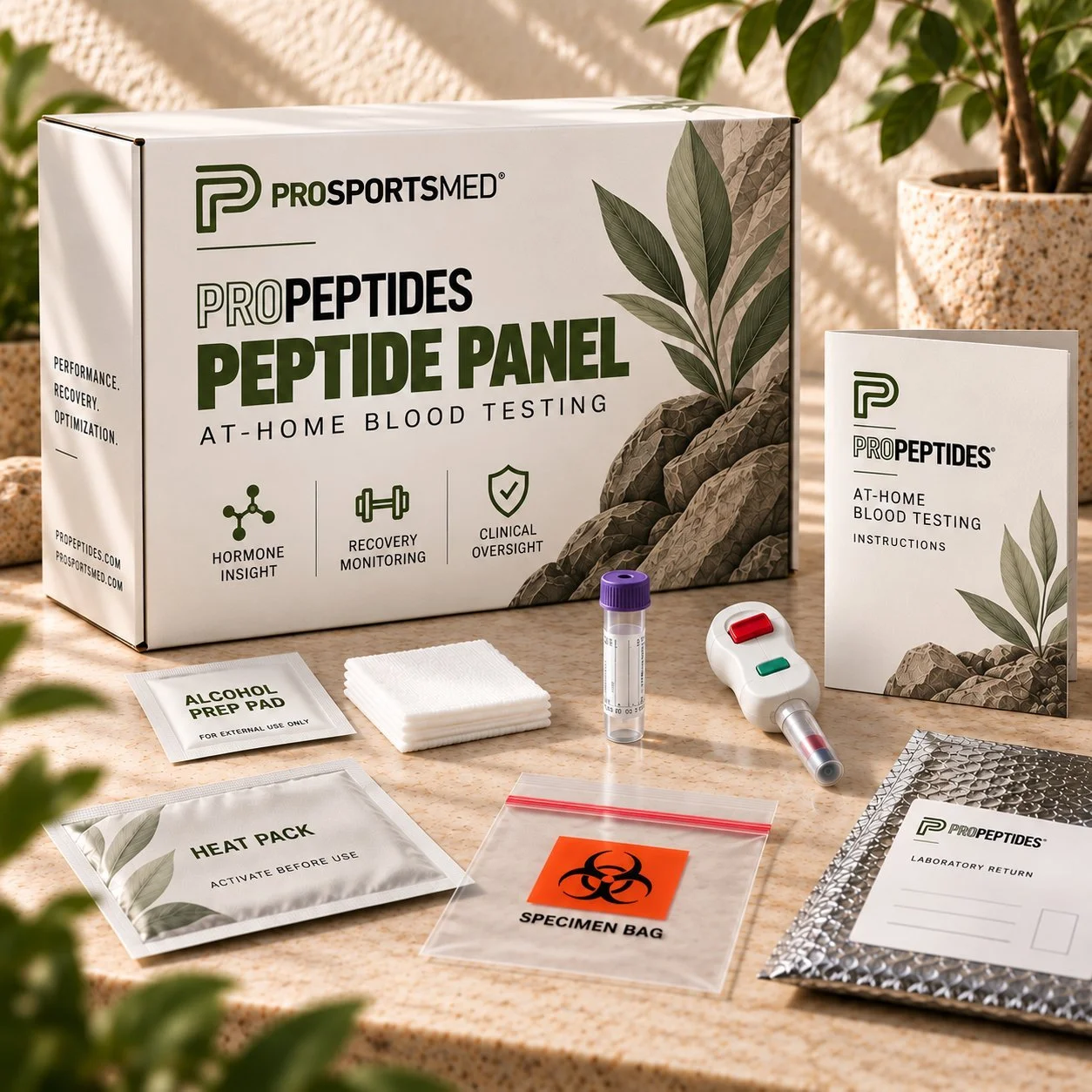
PRO Peptide Panel
IGF-1, Blood Count, Organ Function, and Hormone Monitoring for Peptide Therapy
PRO Sports Medicine Learning Center
Introduction
Peptide therapy is often described in terms of what people hope to feel: better recovery, better sleep, better body composition. But peptides act on real physiology, and some of that physiology can be measured. Growth hormone pathway peptides change IGF-1. Many therapies are processed by the liver and kidneys. Hormone, thyroid, glucose, and inflammatory status all shape how a person responds.
The PRO Peptide Panel brings those measurements together in a single 25-biomarker at-home test for men or women. It is designed to establish baseline values before a peptide protocol, monitor selected markers during treatment, and identify changes that deserve clinical attention. It uses two EasyDraw collection devices. In PRO's combination packages, this panel is referred to as the Peptide Performance Panel.
What the Panel Measures
Complete blood count (CBC), 10 markers: hematocrit, hemoglobin, red blood cell count, white blood cell count, platelet count, MCV, MCH, MCHC, RDW, and MPV (without differential).
Metabolic and organ function, 8 markers: ALT, AST, alkaline phosphatase (ALP), albumin, blood urea nitrogen (BUN), creatinine, total bilirubin, and total protein.
Hormones and growth factors, 4 markers: total testosterone, SHBG, TSH, and insulin-like growth factor 1 (IGF-1).
Inflammation and glucose regulation, 2 markers: hsCRP and hemoglobin A1c.
Sex-specific, 1 marker: PSA in the male panel or progesterone in the female panel.
IGF-1: The Centerpiece
Insulin-like growth factor 1 (IGF-1) is produced mainly by the liver in response to growth hormone. Growth hormone itself is released in short pulses, mostly during deep sleep, so a single growth hormone measurement is almost meaningless. IGF-1, by contrast, stays relatively stable through the day, which makes it the standard practical marker of growth hormone activity.
Peptides that act on the growth hormone axis are designed to increase the body's own growth hormone release. These include growth hormone-releasing hormone analogs such as tesamorelin and CJC-1295, and ghrelin-receptor agonists such as ipamorelin. When these peptides are working as intended, IGF-1 typically rises.
Monitoring IGF-1 helps a provider:
Confirm a biological response to growth hormone pathway therapy
Keep IGF-1 within an age-appropriate range rather than pushing it too high
Identify elevations that warrant dose changes or further evaluation
IGF-1 reference ranges are strongly age-dependent, peaking in adolescence and declining steadily through adulthood, so results are always compared with age-specific ranges. IGF-1 is also lowered by undernutrition, low protein intake, liver disease, and poorly controlled diabetes, and it is influenced by estrogen, including oral estrogen therapy.
It is just as important to understand what IGF-1 does not tell us. It does not measure tissue healing, tendon repair, or recovery, and it is not a meaningful marker for peptides that do not act on the growth hormone axis, such as BPC-157 or thymosin alpha-1. Some peptides used in wellness settings are investigational and are not FDA-approved for human use; laboratory monitoring supports oversight but does not establish a peptide's safety or effectiveness.
The Blood Count
The CBC provides a broad view of red cells, white cells, and platelets. Hematocrit, hemoglobin, and red cell count describe oxygen-carrying capacity; MCV, MCH, MCHC, and RDW describe the size and hemoglobin content of red cells, which can reveal developing iron, B12, or folate problems; white cell count reflects immune activity; and platelets and MPV describe clotting cells. A baseline CBC is valuable for anyone starting a new therapy, and especially for patients also on testosterone, which can raise hematocrit. The PRO HRT Monitoring Panel chapter explains each CBC marker in depth.
Liver and Kidney Function
ALT and AST are enzymes released when liver cells are stressed. AST is also found in muscle, so hard training can raise it. ALP comes from liver and bone. Total bilirubin is a breakdown product of red blood cells processed by the liver; a mild, isolated elevation is often due to a common, harmless genetic variant called Gilbert syndrome, especially after fasting. Albumin and total protein reflect the liver's protein production and overall nutrition.
Creatinine and BUN reflect kidney filtration, along with muscle mass, hydration, and protein intake. Athletes with more muscle often have slightly higher creatinine.
Together these markers provide an organ-function baseline before therapy and a way to detect unexpected changes during treatment.
Hormones and Thyroid
Total testosterone and SHBG describe androgen status. Growth hormone pathway activity, weight change, and insulin sensitivity can all influence SHBG. TSH screens thyroid function, which affects energy, metabolism, and body composition and is relevant when growth hormone pathway therapy is used, since thyroid and growth hormone physiology interact.
Inflammation and Glucose
hsCRP measures low-grade systemic inflammation and provides context for recovery, metabolic health, and cardiovascular risk. HbA1c reflects average blood sugar over about three months. It matters in peptide therapy because growth hormone has effects that oppose insulin, and higher growth hormone activity can reduce insulin sensitivity in some people. Tracking HbA1c helps confirm that glucose regulation stays healthy during treatment.
Sex-Specific Markers
PSA (male panel) provides information about prostate health and is particularly relevant for men also receiving testosterone therapy. Progesterone (female panel) provides information about ovulation and reproductive hormone status and must be interpreted with cycle timing, menopausal status, and any hormone therapy.
Who the Panel Is For
Anyone starting a medically supervised peptide program who needs a baseline
Patients using tesamorelin, ipamorelin, CJC-1295, or other growth hormone pathway peptides
Patients who need liver and kidney monitoring during treatment
Patients who want testosterone, thyroid, inflammation, and glucose tracked alongside IGF-1
How to Prepare
Follow the kit instructions; this panel uses two collection devices, so allow time.
Ask your provider when to collect relative to your peptide doses, and keep timing consistent between tests.
Collect in the morning for the most consistent testosterone result.
Avoid heavy training for a day or two beforehand, which can raise AST and creatinine.
Hydrate well, and tell your provider about all supplements, including biotin and creatine.
How Your Results Are Reviewed
A PRO Sports Medicine provider reviews your results alongside your peptide protocol, dosing schedule, goals, and history. The review focuses on whether IGF-1 is in an appropriate, age-adjusted range, whether organ function, blood count, glucose, and inflammation are stable, and whether any finding needs follow-up. Clinical review is included for active PRO Foundations members.
How It Fits PRO Care
The Peptide Panel is typically ordered before starting a growth hormone pathway protocol and again at intervals your provider sets based on the therapy and your results. Patients who want broader coverage can combine it with another panel: the PRO Core + Peptide Performance Panel, the PRO Women's Health + Peptide Performance Panel, or the PRO Performance + Peptide Performance Panel. For background on how growth signaling relates to aging, see Nutrient Sensing and Intercellular Communication.
Important Information
This article is educational and is not medical advice. This panel supports health assessment and clinical monitoring. It does not establish the effectiveness or safety of any peptide therapy. Some peptides discussed are investigational and are not FDA-approved for human therapeutic use. All results are reviewed by a licensed PRO Sports Medicine provider.
Key References
Clemmons DR. Consensus Statement on the Standardization and Evaluation of Growth Hormone and Insulin-like Growth Factor Assays. Clin Chem. 2011.
American Diabetes Association Professional Practice Committee. Diagnosis and Classification of Diabetes: Standards of Care in Diabetes. Diabetes Care (updated annually).
U.S. Food and Drug Administration. Safety Communication: Biotin (Vitamin B7) May Interfere With Lab Tests. 2017, updated 2019.
Clinical Perspective
IGF-1 is the most useful single laboratory marker for growth hormone pathway peptides, but it is only one piece of a responsible monitoring plan. Pairing it with glucose regulation, organ function, blood count, thyroid, and hormone markers lets a provider confirm response, avoid excess, and catch unexpected changes early, while keeping expectations honest about what laboratory data can and cannot show.