
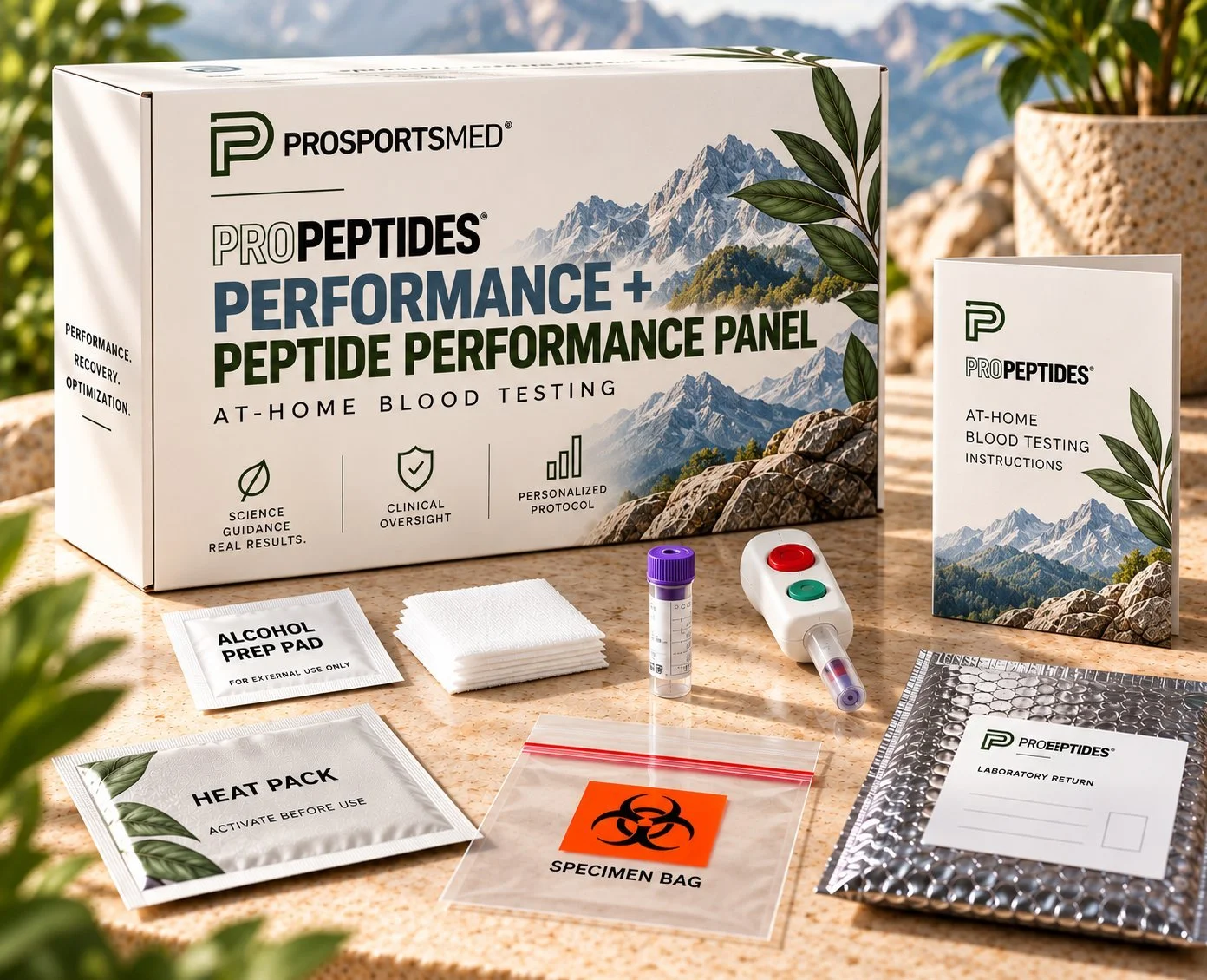
PRO Performance + Peptide Performance Panel
Our Most Comprehensive Package for Peptide Therapy, Performance, and Longevity Monitoring
PRO Sports Medicine Learning Center
Introduction
For patients who want the most complete laboratory picture PRO offers, there is the PRO Performance + Peptide Performance Panel. It combines the PRO Performance Panel, our 41-biomarker comprehensive assessment, with the PRO Peptide Panel (the Peptide Performance Panel in PRO's combination packages), which adds IGF-1, a complete blood count, and additional chemistry relevant to peptide therapy.
It is designed for patients beginning or using peptide therapy, athletes focused on recovery and performance, patients on hormone optimization, and anyone pursuing a serious, data-driven approach to long-term health.
What the Combination Covers
From the Performance Panel:
Cardiovascular and metabolic: lipid panel, ApoB, ApoA1, Lp(a), HbA1c, C-peptide, and hsCRP
Hormones: total and free testosterone, SHBG, estradiol, DHEA-S, prolactin, LH, FSH, cortisol, and progesterone (female) or PSA (male)
Thyroid: TSH, free T3, free T4, anti-TPO, and anti-TG antibodies
Liver and kidney: ALT, AST, ALP, total and direct bilirubin, creatinine, BUN, eGFR, albumin, total protein, and calcium
Nutrients and iron: vitamin D, B12, folate, ferritin, serum iron, UIBC, TIBC, and iron saturation
From the Peptide Panel:
IGF-1
A complete blood count with 10 markers
Liver and kidney chemistry, total testosterone, SHBG, TSH, hsCRP, HbA1c, and PSA (male) or progesterone (female), several of which overlap with the Performance Panel
Each biomarker is explained in the PRO Performance Panel and PRO Peptide Panel chapters.
Why Combine These Two Panels
IGF-1 plus the full endocrine picture. IGF-1 is shaped by nutrition, liver function, thyroid status, and sex hormones. This combination measures all of them, which allows the most accurate interpretation of IGF-1 during growth hormone pathway therapy with peptides such as tesamorelin, ipamorelin, or CJC-1295.
Glucose regulation in detail. Growth hormone opposes insulin's effects. The combination includes both HbA1c and C-peptide, so a provider can see not only average glucose but also how hard the pancreas is working to maintain it.
A complete blood count. The Performance Panel does not include a CBC on its own. The Peptide component adds it, which is especially important for patients also on testosterone.
Recovery and fatigue, fully mapped. Iron studies, B12, folate, free T3, cortisol, and hormone markers cover the most common physiological causes of poor recovery, so problems are less likely to be missed or misattributed.
A long-term cardiovascular lens. ApoB, Lp(a), ApoA1, and hsCRP provide a thorough view of cardiovascular risk, an essential part of any longevity plan.
A Practical Monitoring Rhythm
Many patients complete this combination as a comprehensive baseline before starting peptide therapy and then periodically, often annually, with the Peptide Panel alone used for interim monitoring. IGF-1 typically responds within weeks of starting a growth hormone pathway peptide, while HbA1c reflects about three months, and Lp(a) is largely genetic and usually needs measuring only once. Your provider sets intervals based on your therapy, results, and goals.
Who the Panel Is For
Patients beginning or using a medically supervised peptide program who want the broadest baseline
Patients using growth hormone pathway peptides that warrant IGF-1 monitoring
Patients on TRT or hormone optimization who also use peptides
Athletes and active adults focused on recovery, performance, and body composition
Adults pursuing comprehensive longevity and preventive monitoring
PRO Foundations members who want the most complete laboratory oversight
How to Prepare
Follow the kit instructions for each component, and allow time for multiple collection devices.
Collect in the morning and note the time, which matters for testosterone and cortisol.
Fast for 8 to 12 hours unless your provider advises otherwise (water is allowed) for consistent lipids, C-peptide, and serum iron.
Ask when to collect relative to peptide and hormone doses, and keep timing consistent between tests.
Women should note their cycle day and any hormone or contraceptive use.
Hydrate well, avoid very hard training for a day or two, and pause high-dose biotin if your provider agrees.
How Your Results Are Reviewed
A PRO Sports Medicine provider reviews the full report with your peptide and hormone protocols, training, symptoms, and history. The review connects findings across systems: whether IGF-1 is appropriate for your age, whether glucose regulation and organ function remain healthy, whether blood count and iron are balanced, and whether thyroid, adrenal, hormone, or cardiovascular findings call for follow-up. Clinical review is included for active PRO Foundations members.
How It Fits PRO Care
This combination supports the integrated approach described throughout our Learning Center. When paired with PRO Foundations, results can be reviewed alongside body composition, activity, nutrition, sleep, and recovery data. For background, see Integrated Systems, Laboratory Assessment & Biomarkers, and Building a Personalized Program.
Order the PRO Performance + Peptide Performance Panel
Important Information
This article is educational and is not medical advice. Results should be interpreted with symptoms, medical history, medications, and treatment protocols. IGF-1 is not a validated measure of the efficacy or safety of all peptide therapies. Some peptides discussed are investigational or not FDA-approved for human use. Testing does not establish treatment safety or effectiveness on its own. All results are reviewed by a licensed PRO Sports Medicine provider.
Key References
Clemmons DR. Consensus Statement on the Standardization and Evaluation of Growth Hormone and Insulin-like Growth Factor Assays. Clin Chem. 2011.
Kronenberg F, Mora S, Stroes ESG, et al. Lipoprotein(a) in Atherosclerotic Cardiovascular Disease and Aortic Stenosis: A European Atherosclerosis Society Consensus Statement. Eur Heart J. 2022.
Sniderman AD, Thanassoulis G, Glavinovic T, et al. Apolipoprotein B Particles and Cardiovascular Disease: A Narrative Review. JAMA Cardiol. 2019.
Garber JR, Cobin RH, Gharib H, et al. Clinical Practice Guidelines for Hypothyroidism in Adults: Cosponsored by the American Association of Clinical Endocrinologists and the American Thyroid Association. Thyroid. 2012.
Clinical Perspective
Comprehensive data is most valuable when it is used to make better decisions, not simply to collect numbers. This combination gives PRO providers the context to interpret IGF-1 accurately, monitor the systems peptide therapy can influence, and identify the real drivers of fatigue, recovery, and long-term risk, so care can be individualized with confidence.