
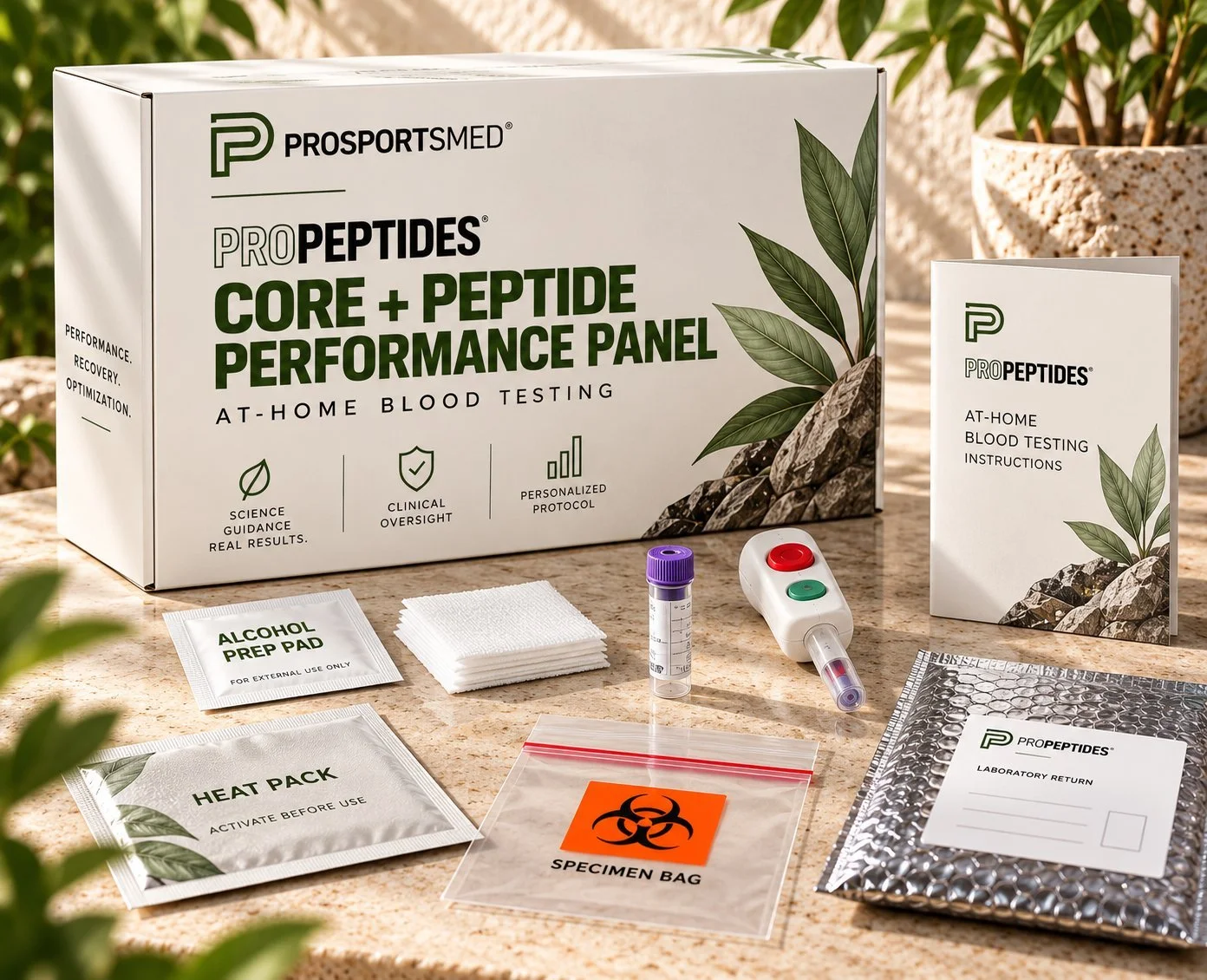
PRO Core + Peptide Performance Panel
Foundational Wellness Testing Plus IGF-1 and Peptide Therapy Monitoring
PRO Sports Medicine Learning Center
Introduction
Starting a peptide program is a good moment to take stock of overall health. The questions a provider asks before a growth hormone pathway peptide, such as tesamorelin, ipamorelin, or CJC-1295, are not only about IGF-1. They also include: What is your cardiovascular risk? How is your blood sugar regulation? Are your liver and kidneys healthy? Are thyroid, vitamin D, iron, and sex hormones in a reasonable place?
The PRO Core + Peptide Performance Panel answers those questions together. It combines the PRO Core Health Panel with the PRO Peptide Panel (called the Peptide Performance Panel in PRO's combination packages), joining foundational wellness screening with the markers most relevant to peptide therapy monitoring.
What the Combination Covers
From the Peptide Panel:
IGF-1, the primary marker of growth hormone pathway activity
A complete blood count with 10 markers
Liver and organ chemistry: ALT, AST, ALP, albumin, total bilirubin, and total protein
Kidney markers: creatinine and BUN
Total testosterone, SHBG, and TSH
hsCRP and HbA1c
PSA (male) or progesterone (female)
From the Core Health Panel:
An expanded lipid panel with ApoB, VLDL, and calculated ratios
Vitamin D and ferritin
Free testosterone (calculated) and albumin for men; estradiol and FSH for women
HbA1c, hsCRP, and TSH, which overlap with the Peptide Panel
Each biomarker is explained in the PRO Core Health Panel and PRO Peptide Panel chapters.
Why Combine These Two Panels
IGF-1 needs context. IGF-1 is lowered by undernutrition, low protein intake, and liver disease, and it is influenced by estrogen and thyroid status. Having nutrition-related markers, liver chemistry, TSH, and sex hormones on the same report helps a provider interpret IGF-1 accurately.
Growth hormone affects glucose. Growth hormone has effects that oppose insulin, so tracking HbA1c alongside lipids and ApoB keeps an eye on overall cardiometabolic health during therapy.
A complete baseline. The Core Health half adds cardiovascular risk markers, vitamin D, and iron stores, which are not part of the Peptide Panel. These often explain fatigue or slow recovery that might otherwise be attributed to the peptide program itself.
More complete hormone data. The Peptide Panel includes total testosterone and SHBG; the Core Health half adds free testosterone for men and estradiol and FSH for women.
Understanding the Overlap
Because both panels include HbA1c, hsCRP, TSH, testosterone, SHBG, and albumin, you may see some markers that appear in both halves of the package. That overlap is intentional in the sense that each underlying panel is complete on its own, and it means these core markers are always available for comparison no matter which panel you repeat later. Your report and your provider's review will treat them as one result each. What the combination adds over either panel alone is breadth: ApoB and a full lipid profile, vitamin D, and ferritin from the Core Health side, and IGF-1, a complete blood count, and detailed liver and kidney chemistry from the Peptide side.
A Practical Monitoring Rhythm
The combination is most valuable as a baseline before starting a peptide protocol. During therapy, your provider may recommend repeating the full combination, or only the Peptide Panel, at intervals based on the specific peptide, your dose, and your results. IGF-1 typically responds within weeks of starting a growth hormone pathway peptide, while markers such as HbA1c reflect a longer window of about three months. Consistent timing between tests, both time of day and timing relative to doses, makes comparisons more reliable.
Who the Panel Is For
Patients beginning a medically supervised peptide program who want a full baseline
Patients using growth hormone pathway peptides that warrant IGF-1 monitoring
Active adults interested in recovery, performance, and body composition
PRO Foundations members who want expanded laboratory monitoring
How to Prepare
Follow the kit instructions for each component.
Collect in the morning for consistent testosterone results, and fast for 8 to 12 hours (water allowed) for lipid consistency unless your provider advises otherwise.
Ask when to collect relative to your peptide doses, and keep that timing consistent.
Women should note their cycle day, since estradiol, FSH, and progesterone vary through the cycle.
Avoid heavy training for a day or two beforehand, hydrate well, and pause high-dose biotin if your provider agrees.
How Your Results Are Reviewed
A PRO Sports Medicine provider reviews your results alongside your peptide protocol, history, and goals. The review focuses on whether IGF-1 is in an appropriate, age-adjusted range, whether glucose regulation, lipids, organ function, and blood count are stable, and whether vitamin D, iron, thyroid, or hormone findings need attention. Clinical review is included for active PRO Foundations members.
How It Fits PRO Care
This panel bridges PRO's foundational wellness care and peptide medicine. It supports the physiology-first approach described throughout our longevity series: understand the baseline, then add targeted therapies, then measure the response. For related reading, see Laboratory Assessment & Biomarkers and Clinical Applications.
Order the PRO Core + Peptide Performance Panel
Important Information
This article is educational and is not medical advice. Laboratory testing supports clinical evaluation and monitoring. IGF-1 is not a validated measure of the efficacy or safety of all peptide therapies. Some peptides discussed are investigational or not FDA-approved for human use. Testing does not establish treatment safety or effectiveness on its own. All results are reviewed by a licensed PRO Sports Medicine provider.
Key References
Clemmons DR. Consensus Statement on the Standardization and Evaluation of Growth Hormone and Insulin-like Growth Factor Assays. Clin Chem. 2011.
Grundy SM, Stone NJ, Bailey AL, et al. 2018 AHA/ACC Multisociety Guideline on the Management of Blood Cholesterol. Circulation. 2019.
American Diabetes Association Professional Practice Committee. Diagnosis and Classification of Diabetes: Standards of Care in Diabetes. Diabetes Care (updated annually).
Clinical Perspective
A peptide program built on a full baseline is easier to manage safely. When IGF-1, glucose regulation, organ function, cardiovascular markers, and nutrient status are all known before therapy starts, later changes can be attributed with more confidence, and unrelated problems, such as low iron or an underactive thyroid, are less likely to be mistaken for a poor response to treatment.