
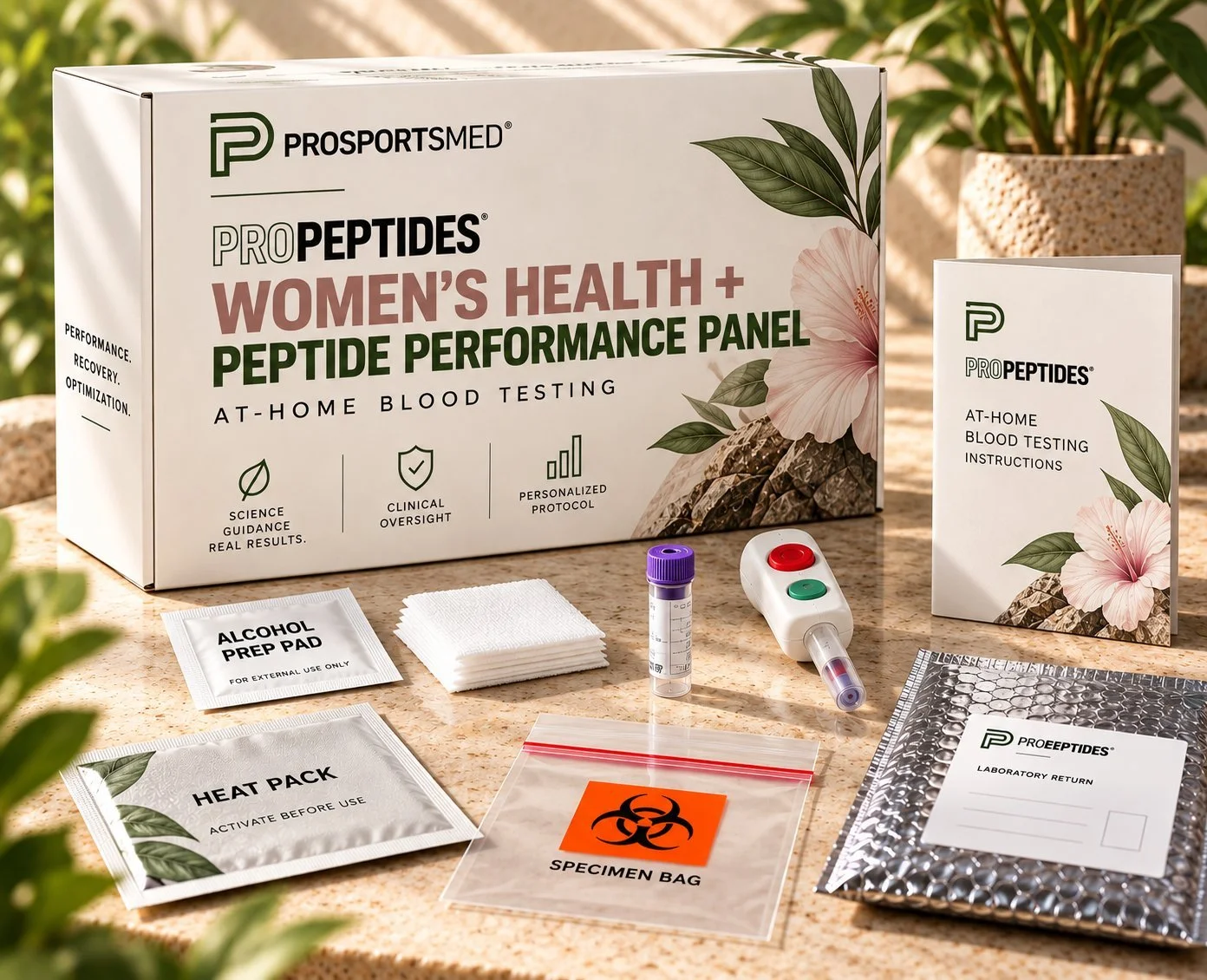
PRO Women's Health + Peptide Performance Panel
Female Hormone Testing Plus IGF-1 and Peptide Therapy Monitoring for Women
PRO Sports Medicine Learning Center
Introduction
Women considering peptide therapy have additional physiology to account for. Estrogen influences how the liver produces IGF-1. Menstrual blood loss affects iron and blood count. Thyroid disorders are more common in women. And perimenopause and menopause reshape hormones, body composition, sleep, and recovery, often at the same stage of life when women seek performance and healthy aging care.
The PRO Women's Health + Peptide Performance Panel combines the PRO Women's Health Panel with the PRO Peptide Panel (the Peptide Performance Panel in PRO's combination packages). It brings together a detailed female hormone profile and the markers most relevant to peptide therapy monitoring in one at-home package.
What the Combination Covers
From the Women's Health Panel:
Reproductive hormones: estradiol, progesterone, LH, FSH, and prolactin
Androgens and hormone balance: total testosterone, free testosterone (calculated), SHBG, DHEA-S, and albumin
Thyroid, metabolic, and iron markers: TSH, free T4, HbA1c, ferritin, and serum iron
From the Peptide Panel:
IGF-1
A complete blood count with 10 markers
Liver and organ chemistry: ALT, AST, ALP, albumin, total bilirubin, and total protein
Kidney markers: creatinine and BUN
Total testosterone, SHBG, TSH, hsCRP, HbA1c, and progesterone
Each biomarker is explained in the PRO Women's Health Panel and PRO Peptide Panel chapters.
Why Combine These Two Panels
Estrogen affects IGF-1. Oral estrogen, whether from contraception or hormone therapy, reduces the liver's IGF-1 production in response to growth hormone, while transdermal estrogen has much less of this effect. Interpreting IGF-1 in a woman therefore requires knowing her estrogen status and any hormone products she uses.
Blood count and iron matter more for women. Menstrual blood loss, particularly heavy periods, is a common cause of low iron and anemia, both of which cause fatigue and limit recovery and exercise tolerance. The CBC from the Peptide Panel and the iron markers from the Women's Health Panel together give a clearer picture.
Symptoms overlap. Fatigue, poor sleep, weight change, and low motivation can come from perimenopausal hormone shifts, thyroid dysfunction, low iron, or under-recovery. Testing all of these together helps a provider avoid attributing symptoms to the wrong cause.
Androgens and adrenal output. DHEA-S, testosterone, and SHBG provide context for libido, energy, and body composition, and help identify patterns, such as androgen excess, that might change a treatment plan.
Understanding the Overlap
Some markers, such as total testosterone, SHBG, albumin, and progesterone, appear in both underlying panels. Each panel is complete on its own, so these shared markers give a consistent reference point whether you later repeat the full combination, the Women's Health Panel alone, or the Peptide Panel alone. What the combination adds is breadth: the full reproductive hormone profile, DHEA-S, and thyroid, metabolic, and iron markers from the Women's Health side, and IGF-1, a complete blood count, liver and kidney chemistry, hsCRP, and HbA1c from the Peptide side.
Life-Stage Considerations
Women's hormone results depend heavily on life stage. In the reproductive years, cycle timing determines what estradiol, progesterone, LH, and FSH should look like. During perimenopause, hormones can swing widely from month to month, so a single test is a snapshot rather than a verdict. After menopause, estradiol and progesterone are low and FSH and LH are high unless hormone therapy is used. Your PRO provider will interpret every result with your age, cycle history, and any hormone or contraceptive use in mind.
Who the Panel Is For
Women beginning or using a medically supervised peptide program
Women using growth hormone pathway peptides that warrant IGF-1 monitoring
Women in perimenopause or menopause, or using hormone replacement therapy
Active women focused on recovery, performance, and body composition
PRO Foundations members who want expanded laboratory monitoring
How to Prepare
Follow the kit instructions for each component.
Ask your provider which cycle day to collect on if you have regular cycles, and note the first day of your last period.
Note any contraception or hormone therapy, including product, dose, route, and time of last dose.
Ask when to collect relative to your peptide doses, and keep timing consistent between tests.
Collect in the morning, hydrate well, avoid hard training for a day or two, and pause high-dose biotin if your provider agrees.
How Your Results Are Reviewed
A PRO Sports Medicine provider reviews the complete report with your life stage, cycle history, hormone use, peptide protocol, and goals. The review covers IGF-1 in an age-appropriate range, reproductive and androgen hormone patterns, blood count and iron, thyroid, organ function, glucose regulation, and inflammation, with recommendations for follow-up testing or treatment adjustments as needed. Clinical review is included for active PRO Foundations members.
How It Fits PRO Care
This combination is designed for women who want peptide therapy guided by a full understanding of their hormonal health. It supports the long-term goals described in Body Composition & Sarcopenia, Brain Health, and Sleep, Recovery & Circadian Health.
Order the PRO Women's Health + Peptide Performance Panel
Important Information
This article is educational and is not medical advice. Results should be interpreted with symptoms, menstrual history, menopausal status, medications, and other clinical findings. IGF-1 is not a validated measure of the efficacy or safety of all peptide therapies. Some peptides discussed are investigational or not FDA-approved for human use. All results are reviewed by a licensed PRO Sports Medicine provider.
Key References
Harlow SD, Gass M, Hall JE, et al. Executive Summary of the Stages of Reproductive Aging Workshop + 10: Addressing the Unfinished Agenda of Staging Reproductive Aging. J Clin Endocrinol Metab. 2012.
Clemmons DR. Consensus Statement on the Standardization and Evaluation of Growth Hormone and Insulin-like Growth Factor Assays. Clin Chem. 2011.
Garber JR, Cobin RH, Gharib H, et al. Clinical Practice Guidelines for Hypothyroidism in Adults: Cosponsored by the American Association of Clinical Endocrinologists and the American Thyroid Association. Thyroid. 2012.
Clinical Perspective
Peptide monitoring in women is more accurate when hormones are measured at the same time. Estrogen route and dose change IGF-1, menstrual losses change blood count and iron, and thyroid disorders are common. Bringing these markers into a single, well-timed panel lets providers interpret each result in context and individualize care for each stage of life.