
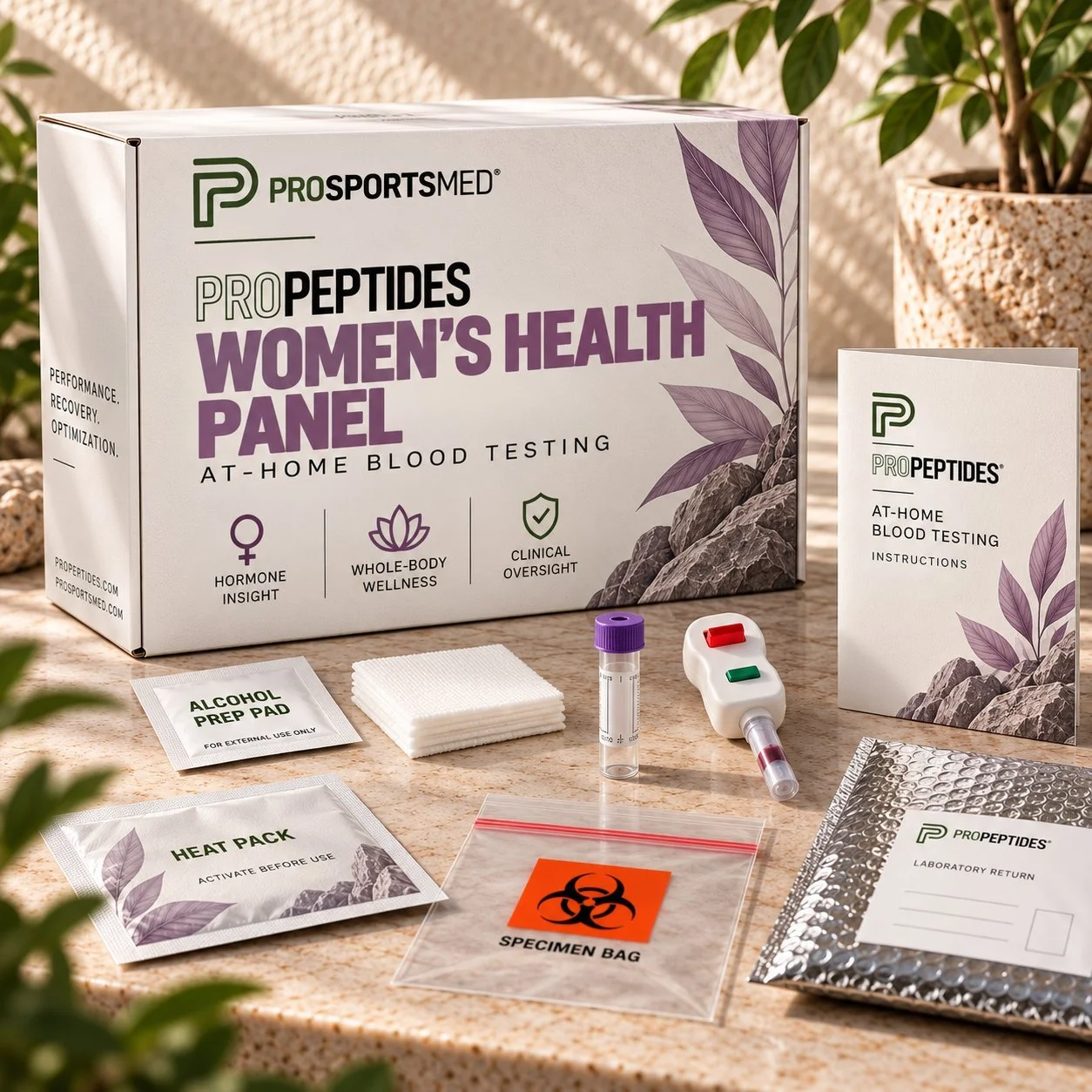
PRO Women's Health Panel
Reproductive Hormones, Androgens, Thyroid, Metabolic Health, and Iron Status for Women
PRO Sports Medicine Learning Center
Introduction
Women's hormones are dynamic by design. Estrogen, progesterone, and the pituitary hormones that control them rise and fall across every menstrual cycle, shift during pregnancy and the postpartum period, and change substantially during perimenopause and menopause. Thyroid function, iron stores, and metabolic health interact with all of it.
That complexity is why symptoms such as fatigue, irregular cycles, sleep disruption, weight changes, low libido, or mood shifts can be hard to sort out without data. The PRO Women's Health Panel is a 15-biomarker at-home blood test designed to provide that data. It covers female reproductive hormones, androgens and hormone balance, and markers of thyroid function, metabolic health, and iron status.
What the Panel Measures
Reproductive hormones: estradiol, progesterone, luteinizing hormone (LH), follicle-stimulating hormone (FSH), and prolactin.
Androgens and hormone balance: total testosterone, free testosterone (calculated), sex hormone-binding globulin (SHBG), DHEA-sulfate (DHEA-S), and albumin.
Thyroid: thyroid-stimulating hormone (TSH) and free thyroxine (free T4).
Metabolic health: hemoglobin A1c (HbA1c).
Iron status: ferritin and serum iron.
The Reproductive Hormones
Estradiol is the dominant estrogen during the reproductive years. It builds the uterine lining in the first half of the cycle and supports bone density, skin, blood vessels, brain function, and mood. Estradiol is lowest during menstruation, peaks just before ovulation, and has a second, smaller rise in the luteal phase. After menopause it falls to low levels. Hormonal contraception suppresses natural estradiol production, and estrogen therapy raises measured levels depending on the product and route.
Progesterone is produced mainly by the corpus luteum after ovulation. It stabilizes the uterine lining, has calming effects on the nervous system, and raises body temperature slightly. Because it is high only after ovulation, a mid-luteal progesterone level, typically drawn about seven days before an expected period, is commonly used to confirm that ovulation occurred. A progesterone drawn at another time of the cycle will naturally be low. During perimenopause, cycles without ovulation become more common, so low progesterone is a frequent finding.
LH (luteinizing hormone) is released by the pituitary and surges mid-cycle to trigger ovulation. Outside of the surge, LH provides context about how the brain and ovaries are communicating. A pattern of LH that is high relative to FSH can be seen in polycystic ovary syndrome, while both LH and FSH rise after menopause.
FSH (follicle-stimulating hormone) stimulates ovarian follicles to grow. As the supply of follicles declines in the years before menopause, the pituitary works harder and FSH rises. FSH is often measured early in the cycle, on roughly day 2 to 5. During perimenopause it can swing widely from month to month, so it is interpreted together with symptoms and cycle history rather than as a stand-alone test for menopause.
Prolactin is a pituitary hormone best known for milk production. Outside of pregnancy and breastfeeding, an elevated prolactin can suppress ovulation and cause irregular or absent periods, breast discharge, or low libido. Stress, poor sleep, recent breast stimulation, exercise, and certain medications, including some antidepressants and antipsychotics, can raise it. A persistently high value warrants further medical evaluation.
Androgens and Hormone Balance
Women produce testosterone and other androgens in the ovaries and adrenal glands. In the right amounts, androgens support libido, energy, muscle, and bone. Too much can contribute to acne, unwanted hair growth, and irregular cycles; too little may be associated with low libido and low energy.
Total testosterone in women is a small fraction of male levels, so accurate low-range measurement matters. It declines gradually with age rather than abruptly at menopause.
SHBG binds testosterone and estradiol. Oral estrogen, including many birth control pills, raises SHBG and lowers free testosterone. Insulin resistance and higher body fat lower SHBG and raise free testosterone.
Albumin binds hormones loosely and is used in the free testosterone calculation. It also reflects nutrition and liver function.
Free testosterone (calculated) estimates the hormone available to tissues and is often more informative than total testosterone in women, particularly when SHBG is unusual.
DHEA-S (DHEA-sulfate) is produced almost entirely by the adrenal glands. It is a precursor to both androgens and estrogens and declines steadily with age. Elevated DHEA-S points toward an adrenal source of excess androgens, while low levels are common with aging and can be seen with some adrenal conditions or steroid use.
Thyroid, Metabolic, and Iron Context
Thyroid disorders are considerably more common in women than in men, and an underactive or overactive thyroid can mimic or worsen hormonal symptoms, including fatigue, weight change, hair thinning, and menstrual irregularity. Iron deficiency is the most common nutrient deficiency in menstruating women and is a frequent, often overlooked contributor to fatigue and reduced exercise tolerance. Metabolic health shifts during the menopausal transition, when changes in estrogen are associated with more abdominal fat and less favorable glucose and lipid patterns. The thyroid, metabolic, and iron markers in this panel help separate these causes from reproductive hormone changes.
TSH and free T4 are read together. TSH is the pituitary's signal to the thyroid, and free T4 is the main hormone the thyroid releases. A high TSH with a low free T4 points toward an underactive thyroid, while a low TSH with a high free T4 points toward an overactive one. A borderline TSH with a normal free T4 often calls for repeat testing rather than treatment.
Ferritin and serum iron describe two sides of iron status. Ferritin reflects stored iron and is the most useful single marker for iron deficiency, although it also rises with inflammation. Serum iron is the iron circulating at the moment of the draw. It shifts with recent meals and time of day, so it is interpreted alongside ferritin rather than on its own.
HbA1c reflects average blood sugar over roughly the past three months. For more on TSH, HbA1c, and ferritin, see the PRO Core Health Panel.
Who the Panel Is For
Women with irregular cycles, PMS changes, or suspected hormonal imbalance
Women in perimenopause or menopause who want to understand their hormones
Women considering or using hormone replacement therapy
Women with symptoms of androgen excess, such as acne or unwanted hair growth
Active women and athletes evaluating fatigue, cycle changes, or iron status
Women building a long-term health and healthy aging plan
How to Prepare
Cycle timing matters. If you have regular cycles, ask your provider which day to collect. Early-cycle testing (around day 2 to 5) is common for FSH, LH, and estradiol, while progesterone is most informative about seven days before your expected period. Write down the first day of your last period.
On hormone therapy or contraception? Note the product, dose, and the time of your last dose. These strongly affect results.
Collect in the morning when possible, which supports consistency for testosterone and other hormones. A fasted sample (8 to 12 hours, water allowed) also steadies serum iron and HbA1c context; ask your provider whether to fast.
Pause high-dose biotin if your provider agrees, because it can interfere with some hormone and thyroid immunoassays.
Avoid breast stimulation and intense exercise shortly before collection, which can raise prolactin.
Follow the kit instructions exactly.
How Your Results Are Reviewed
Women's hormone results only make sense in context: age, cycle day, menopausal status, contraception, hormone therapy, and symptoms. A PRO Sports Medicine provider reviews your results with all of that in mind, explains what the pattern suggests, and recommends next steps, which may include repeat testing at a specific cycle day, additional evaluation, or lifestyle and treatment discussions. Clinical review is included for active PRO Foundations members.
How It Fits PRO Care
The Women's Health Panel is often the foundation for women's hormone care at PRO and an important baseline before peptide therapy. Women who are also starting a growth hormone pathway peptide can choose the PRO Women's Health + Peptide Performance Panel to add IGF-1, a blood count, and chemistry markers. Hormonal changes in midlife also affect muscle, bone, cardiovascular, and brain health; see Body Composition & Sarcopenia, Cardiovascular Health, and Brain Health.
Order the PRO Women's Health Panel
Important Information
This article is educational and is not medical advice. Hormone results vary with cycle timing, age, menopausal status, and medications, and a single result does not diagnose any condition. All results are reviewed by a licensed PRO Sports Medicine provider. This panel is not a pregnancy test and is not a fertility assessment.
Key References
Harlow SD, Gass M, Hall JE, et al. Executive Summary of the Stages of Reproductive Aging Workshop + 10: Addressing the Unfinished Agenda of Staging Reproductive Aging. J Clin Endocrinol Metab. 2012.
Garber JR, Cobin RH, Gharib H, et al. Clinical Practice Guidelines for Hypothyroidism in Adults: Cosponsored by the American Association of Clinical Endocrinologists and the American Thyroid Association. Thyroid. 2012.
U.S. Food and Drug Administration. Safety Communication: Biotin (Vitamin B7) May Interfere With Lab Tests. 2017, updated 2019.
Clinical Perspective
Hormone testing in women is most useful when it is timed and interpreted thoughtfully. A progesterone drawn on the wrong day or an FSH drawn during a perimenopausal swing can be misleading. Pairing reproductive hormones with androgens, thyroid, metabolic, and iron markers allows a provider to separate overlapping causes of very similar symptoms, and to build a plan grounded in the patient's actual physiology.