
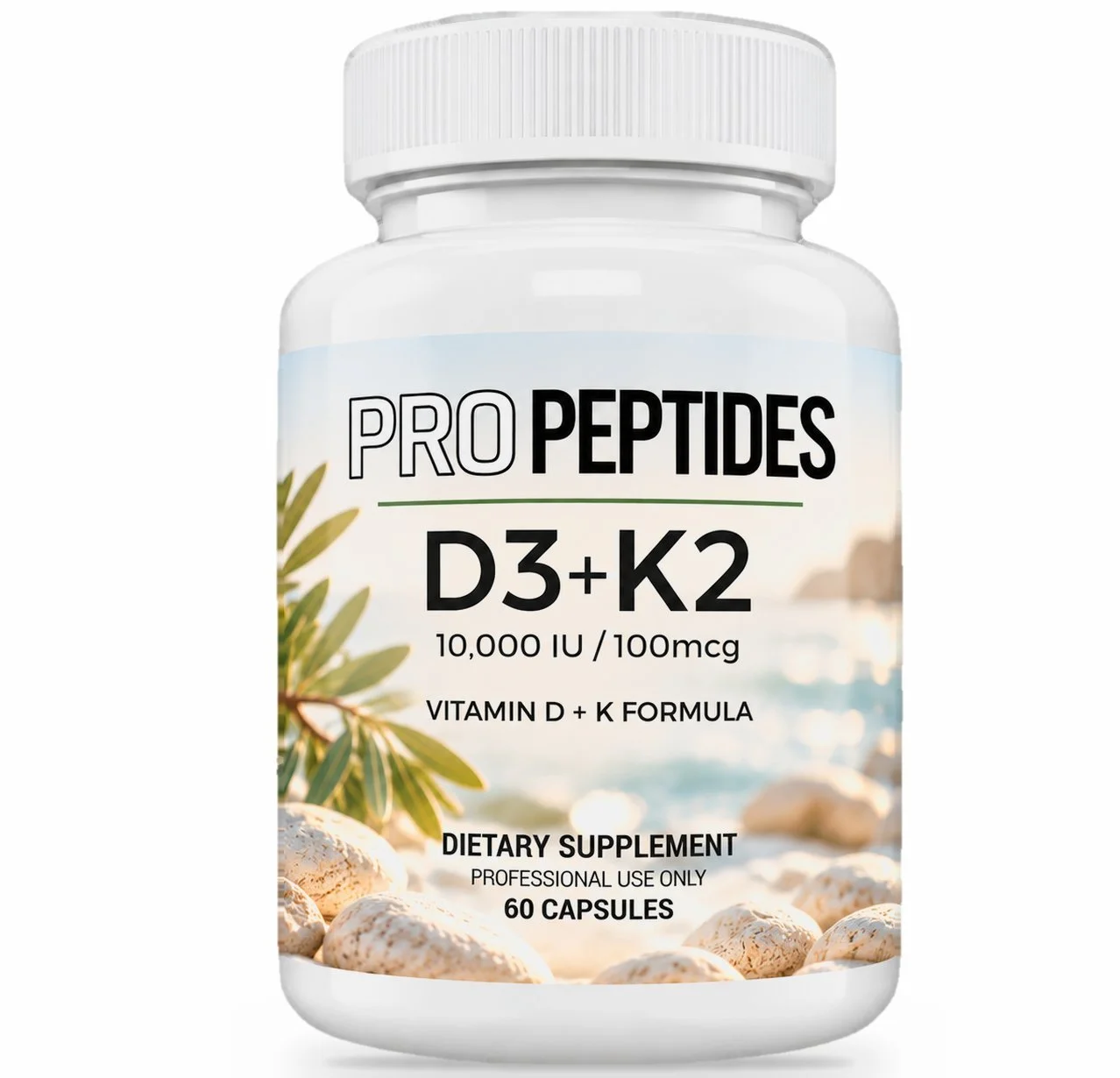
Vitamin D3 10,000 IU with Vitamin K2
High-Potency Daily Vitamin D3 With 100 mcg Vitamin K2 (MK-7) for Provider-Directed, Laboratory-Guided Use
PRO Sports Medicine Learning Center
Introduction
Vitamin D is unusual among vitamins. The body can make it in the skin from sunlight, it is stored in fat tissue, and once activated it behaves more like a hormone than a typical vitamin, signaling through vitamin D receptors found in tissues throughout the body. Many people, especially those with darker skin, limited sun exposure, higher body fat, or certain absorption problems, have low vitamin D status.
PRO Therapeutics Vitamin D3 10,000 IU is a high-potency daily capsule that pairs 10,000 IU of vitamin D3 with 100 mcg of vitamin K2 as menaquinone-7 (MK-7). It is intended for adults whose healthcare provider, guided by laboratory testing, determines that a higher daily dose is appropriate for a defined period. It is not a routine maintenance supplement. Each bottle contains 60 capsules, a 60-day supply at one capsule daily when directed.
Formulation (per capsule)
Vitamin D3 (as cholecalciferol): 250 mcg, equivalent to 10,000 IU (1,250% Daily Value)
Vitamin K2 (as menaquinone-7, MenaQ7®): 100 mcg (Daily Value not established)
Other ingredients: microcrystalline cellulose and hypromellose vegetable capsule (kosher).
Ingredients are from the bottle's Supplement Facts label, which is the final word on the formula.
How Vitamin D Works
Vitamin D3 (cholecalciferol) is the same form the skin makes in response to sunlight. After absorption, the liver converts it to 25-hydroxyvitamin D [25(OH)D], the main circulating form and the one measured on lab tests. The kidneys and other tissues then convert 25(OH)D to the active hormone, calcitriol, which binds vitamin D receptors and regulates gene activity.
Vitamin D's best-established roles are:
Calcium and phosphate regulation: active vitamin D increases calcium absorption from the gut and helps maintain normal blood calcium.
Bone mineralization: adequate vitamin D is required for building and maintaining healthy bone.
Muscle and neuromuscular function: vitamin D receptors in muscle support normal muscle contraction and strength.
Immune function and cellular signaling: vitamin D contributes to normal immune system function.
Vitamin K2 (100 mcg, as MK-7)
What it is: vitamin K is a family of fat-soluble compounds. Vitamin K1 comes mainly from leafy greens and is used chiefly by the liver for blood clotting. Vitamin K2, the menaquinones, comes from fermented foods and some animal foods. MK-7 is a long-acting form of K2 that stays in the blood for days, which allows steady levels with once-daily dosing.
How it works: vitamin K activates proteins that handle calcium. Two matter most here: osteocalcin, which helps bind calcium into bone, and matrix Gla protein, which helps keep calcium out of blood vessel walls and other soft tissues. Vitamin D increases the body's production of these proteins, and vitamin K switches them on. That is the rationale for pairing the two, particularly at higher vitamin D doses that increase calcium absorption.
What research shows: the biology of vitamin K-dependent proteins is well established. Clinical trials of K2 supplementation for bone density, fracture risk, and arterial stiffness have produced mixed results: some show benefits, particularly in postmenopausal women, and others show little effect. Evidence that adding K2 makes high-dose vitamin D safer has not been established in large trials. K2 is best viewed as a reasonable complement to vitamin D, not a safeguard that replaces monitoring.
What Research Generally Shows
Bone and muscle: the role of adequate vitamin D in bone mineralization and normal muscle function is well established.
Fatigue: in a randomized, double-blind, placebo-controlled trial in adults with low vitamin D and fatigue, vitamin D3 supplementation improved self-reported fatigue more than placebo. Vitamin D is not a stimulant; improvements in energy are expected mainly when low vitamin D was contributing.
Immune and general health: adequate vitamin D supports normal immune function, but high-dose supplementation has not been shown to be a general way to improve health outcomes in people whose vitamin D status is already adequate.
Daily versus intermittent dosing: the Endocrine Society's 2024 guideline suggested daily, lower-dose vitamin D rather than intermittent high doses for adults aged 50 and older with an indication for supplementation. That guideline does not establish 10,000 IU daily as a routine dose; the right dose depends on the individual.
Evidence strength: strong for vitamin D's physiological roles and for restoring low levels; limited for benefits of high doses in people with adequate levels.
Understanding the Dose
The recommended dietary intake for most healthy adults is about 600 to 800 IU per day.
The adult tolerable upper intake level is 4,000 IU per day for routine, unsupervised use.
10,000 IU daily is 2.5 times that upper level and supplies 70,000 IU per week, more than a conventional 50,000 IU once-weekly regimen. These regimens are not interchangeable.
Higher doses are sometimes used for a limited period under medical supervision to restore low vitamin D status, followed by reassessment and a lower maintenance dose. That is the setting this product is designed for.
The PRO Approach: Test, Supplement, Reassess
1. Baseline testing. Before high-dose use, a serum 25(OH)D test establishes vitamin D status. Depending on your history, your provider may also check calcium and kidney function. The PRO Core Health Panel includes vitamin D, and the PRO Performance Panel adds calcium and kidney markers.
2. An individualized plan. Your provider considers your starting level, the likely cause of low status, current supplements, prior response, calcium intake, kidney function, medications, and any conditions affecting absorption.
3. Reassessment. Follow-up testing is commonly done after about 8 to 12 weeks, though your provider may choose a different interval. Results guide whether to continue for a defined period, lower the dose, switch to maintenance, investigate a poor response, or stop.
The goal is not to push vitamin D as high as possible. It is to support a healthy vitamin D level safely and maintain it.
Who It May Suit
With an individualized clinical assessment, this product may be appropriate for:
Adults with laboratory-confirmed low vitamin D who need a provider-directed higher-dose regimen
Patients who have not responded adequately to conventional doses
People with conditions that reduce vitamin D absorption
Patients participating in a medically supervised supplementation program
It is not recommended as routine daily supplementation for healthy adults without a specific indication.
How to Take It
Take one capsule daily only when specifically recommended by your healthcare provider, with food and a glass of water, as the label directs. A meal that contains some fat supports absorption of both vitamin D and vitamin K2. Do not take more than one capsule per day. Duration should be set by your provider and confirmed with follow-up testing.
Safety, Interactions, and Contraindications
Do not exceed one 10,000 IU capsule daily, and do not use this dose without your provider's guidance.
Toxicity: vitamin D is fat-soluble and accumulates. Excess intake can raise blood calcium (hypercalcemia). Symptoms can include nausea, vomiting, loss of appetite, muscle weakness, excessive thirst, frequent urination, dehydration, confusion, and kidney stones. Severe toxicity can cause kidney injury, calcium deposits in soft tissues, and heart rhythm problems. Contact your provider promptly if you notice these symptoms.
Vitamin K2 and blood thinners: vitamin K directly counteracts warfarin and similar vitamin K antagonist anticoagulants. Even 100 mcg of K2 daily can change INR results. If you take warfarin, do not start this product without your prescribing clinician's approval and INR monitoring. Tell your provider about any other blood-thinning medication as well.
Count every source: PRO FOUNDATIONS contains 1,000 IU of vitamin D3 and 120 mcg of vitamin K2, so taking both supplies 220 mcg of K2 daily. Tell your provider about multivitamins, calcium supplements, and any other vitamin D products to avoid unintended cumulative dosing.
Higher-risk conditions: people with high blood calcium, certain kidney disorders, granulomatous diseases such as sarcoidosis, or certain lymphomas, or who take medications affecting calcium (such as thiazide diuretics), need additional precautions or a different approach.
Medication interactions: some medications, including certain anticonvulsants, glucocorticoids, and weight-loss drugs that reduce fat absorption, affect vitamin D levels. Digoxin users need extra caution because high calcium can affect heart rhythm.
Pregnancy and nursing: use only under direct medical guidance.
Under 18: the label advises that children under 18 consult a physician before use; this high-potency product is intended for adults.
How It Fits PRO Programs
Vitamin D3 10,000 IU with K2 is one of PRO's provider-guided products. It is used when testing shows a need, paired with follow-up labs, and transitioned to an appropriate maintenance plan once levels are restored. Vitamin D status affects muscle function and recovery, which connects it to Body Composition & Sarcopenia and Immunosenescence. Patients who prefer a once-weekly schedule may discuss Vitamin D3 50,000 IU with their provider.
FDA Disclaimer
These statements have not been evaluated by the Food and Drug Administration. This product is not intended to diagnose, treat, cure, or prevent any disease. High-dose supplementation should be undertaken only with appropriate healthcare provider supervision. This information is educational and does not replace individualized medical advice.
Key References
National Institutes of Health, Office of Dietary Supplements. Vitamin D: Fact Sheet for Health Professionals.
Nowak A, et al. Effect of vitamin D3 on self-perceived fatigue: a double-blind randomized placebo-controlled trial. Medicine (Baltimore). 2016.
Demay MB, et al. Vitamin D for the Prevention of Disease: An Endocrine Society Clinical Practice Guideline. J Clin Endocrinol Metab. 2024.
Clinical Perspective
High-potency vitamin D is a useful tool when it is matched to a measured need and followed with repeat testing. The risks of vitamin D come almost entirely from unmonitored, prolonged high-dose use and from stacking multiple products. A clear plan, with baseline 25(OH)D, a defined course, follow-up testing, and a step down to maintenance, captures the benefit while avoiding the harm.